 GLOBEWICK
Marketing Approach: Types, Examples and How to Choose Yours
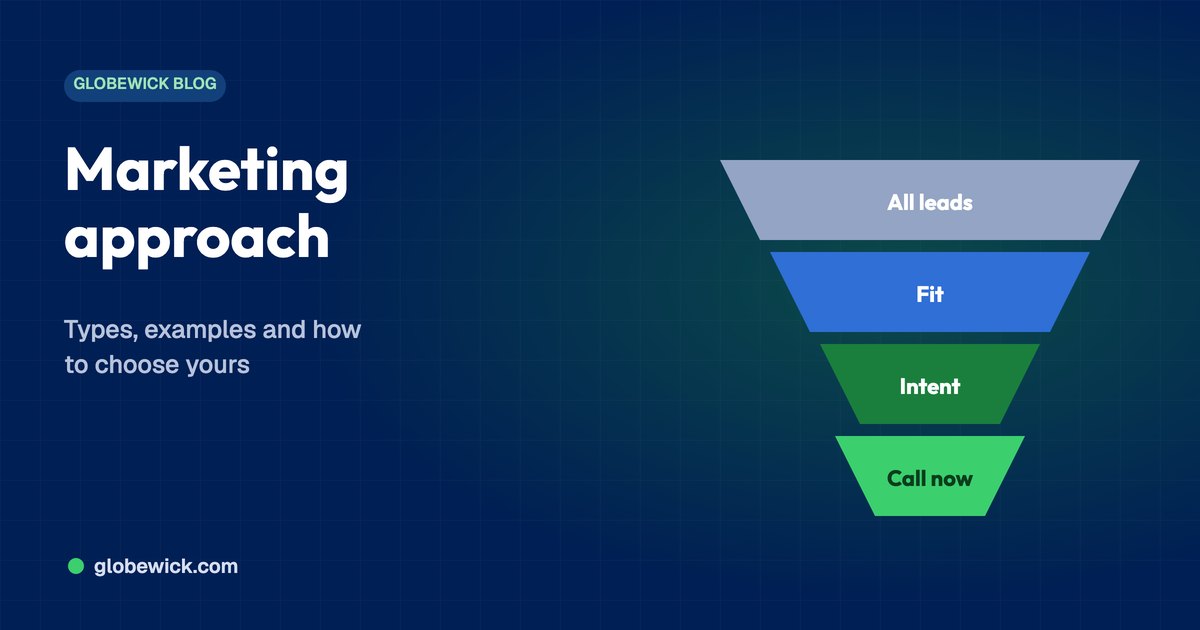
A marketing approach is the overall way a business chooses to win customers: who it targets, which channels it relies on, and how it balances short-term sales against long-term brand. Common approaches include performance-led, brand-led, inbound, outbound, account-based, integrated and social marketing. Most growing businesses combine two or three, with one clearly in the lead.
"Marketing approach" was searched 100 to 1,000 times a month in both India and the United States, and "integrated marketing approach" and "social marketing approach" were each searched 10 to 100 times a month in each country, according to Google Ads Keyword Planner data we pulled in November 2026.
What is a marketing approach?
Think of three levels. Your marketing approach is the philosophy: for example "we grow mainly through paid social and repeat purchases". Your marketing strategy turns that into goals, audiences, positioning and budget. Your tactics are the campaigns, ads, posts and emails you actually run. If you need the strategy level in detail, read our marketing strategy guide.
The approach matters because it decides what you say no to. A small team cannot do SEO, Meta, Google, LinkedIn, influencers, events and PR all at once. A clear approach tells everyone where effort and money go first.
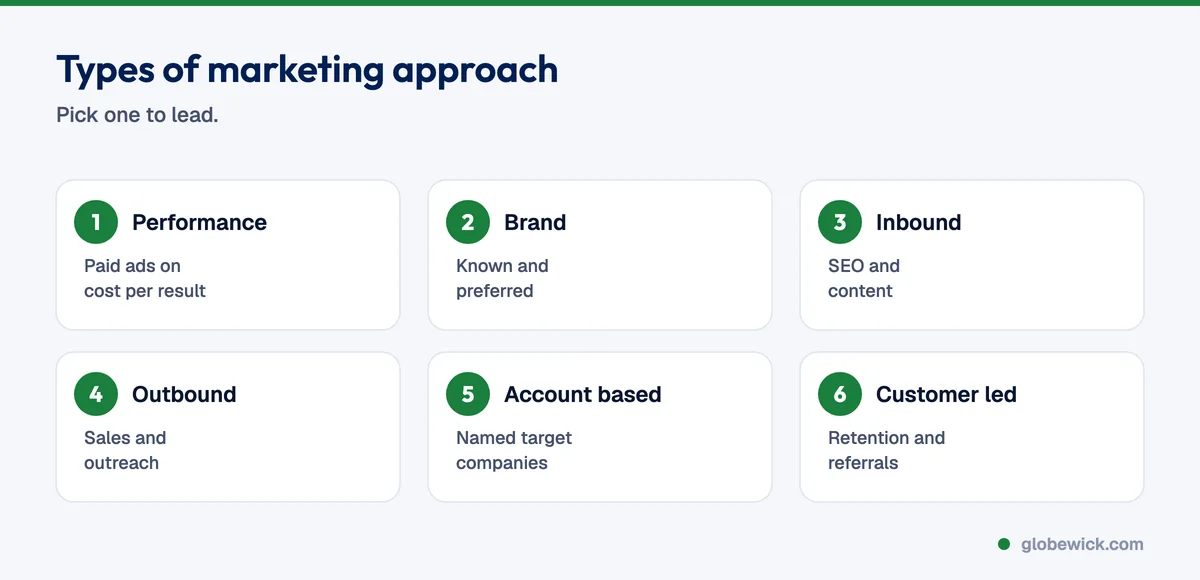
What are the main types of marketing approach?
These are the approaches we see most often across the clients and markets we work in.
1. Performance-led approach
Growth comes mainly from paid channels measured on cost per lead or cost per purchase: Meta ads, Google Search, Shopping and YouTube. It is fast and measurable, and it suits D2C brands and lead generation businesses that know their margins. The risk is dependence on rising ad costs. See what performance marketing is.
2. Brand-led approach
Investment goes into being known and preferred: positioning, identity, content, video and PR. Results arrive more slowly but make every other channel cheaper later. Our brand marketing guide covers this.
3. Inbound approach
Customers find you through useful content, search rankings and social posts, then come to you. SEO, blogs, YouTube and email nurture are the main tools. It suits businesses with a considered purchase and a longer sales cycle.
4. Outbound approach
You go to customers directly: sales calls, cold email, LinkedIn outreach, trade shows and direct mail. It is common in B2B with high deal values and a small, known list of buyers.
5. Account-based approach
Sales and marketing pick a list of named target companies and run tailored ads, content and outreach to people inside them. It is a focused version of B2B marketing. More in our B2B marketing guide.
6. Customer-led and relationship approach
Growth comes from keeping and expanding existing customers: retention flows, loyalty, referrals and community. For many D2C brands this is where profit lives. Read why repeat purchase rate matters more than first-order ROAS.
7. Integrated approach
All channels share one message, one audience definition and one measurement plan, and each channel has a defined job in the customer journey. We cover it in detail below.
8. Social marketing approach
This one is often confused with social media marketing. Social marketing is using marketing methods to change behaviour for a public or social good: health campaigns, road safety, saving water, quitting tobacco. Governments, NGOs and healthcare brands use it. It focuses on the barriers that stop people acting and the benefits that would make them act, rather than on selling a product.
How do the approaches compare?
| Approach | Main channels | Speed to results | Best for |
|---|---|---|---|
| Performance-led | Meta, Google, YouTube ads | Days to weeks | D2C, lead generation, known margins |
| Brand-led | Video, content, PR, creators | Months | Crowded categories, premium pricing |
| Inbound | SEO, blog, email, organic social | 3 to 12 months | Considered purchases, services, B2B |
| Outbound | Sales calls, email, LinkedIn | Weeks | High deal values, small buyer lists |
| Account-based | LinkedIn ads, tailored content, sales | Months | Enterprise B2B |
| Customer-led | Email, WhatsApp, loyalty, referrals | Weeks | Repeat-purchase products |
| Integrated | A planned mix of the above | Builds over time | Brands past the first stage of growth |
| Social marketing | Public campaigns, community, media | Months to years | Behaviour change, health, public causes |
What is an integrated marketing approach?
An integrated marketing approach (often called integrated marketing communications, or IMC) means every touchpoint tells the same story and hands the customer on to the next step. A person might see a Reel, search your brand on Google, read a comparison article on your site, join your WhatsApp list and buy after a reminder. In an integrated plan, each of those steps was designed, and you can see the path in your analytics.
What makes it different from simply "being on many channels":
- One core message and one offer per campaign, adapted to each format.
- Defined roles: each channel has a job, such as reach, consideration, conversion or retention.
- Shared audiences: people who watched your video are retargeted in search and email.
- One measurement view: blended cost per customer, not five separate platform reports that each claim the same sale.
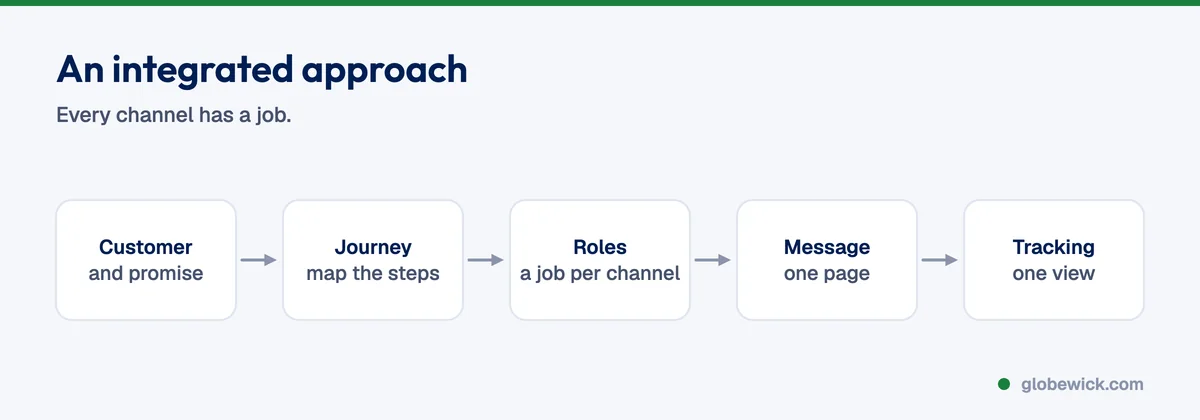
How do you build an integrated marketing approach?
- Define the customer and the promise. Who you are for and why they should choose you. Our guide to segmentation, targeting and positioning helps here.
- Map the journey. List the steps a typical customer takes from first hearing about you to buying again.
- Give each step a channel and a job. For example: Meta and YouTube for reach, Google Search for intent, landing page for conversion, email and WhatsApp for follow-up and repeat orders.
- Write one message house. A single page with the main promise, three proof points and the offer. Every brief to a designer, writer or media buyer starts from it.
- Connect the tracking. UTM parameters on every link, one analytics property, server-side events where possible, and a CRM or store that records the source of each customer.
- Review together, not in silos. One monthly meeting where paid, SEO, social and retention look at the same numbers.
How do you choose the right marketing approach?
Ask four questions.
- Do people already search for what you sell? If yes, search (paid and organic) should be part of the lead approach. If no, you need demand creation through social and video first.
- How long is the buying decision? Impulse and low-price products suit performance-led. Expensive or risky purchases need inbound content and nurture.
- Do customers buy again? If repeat purchase is high, customer-led retention should take a large share of effort.
- What can your team sustain? An approach that needs weekly video, daily ads and monthly PR fails if there is one person doing marketing part time.
Your business stage also matters. Early-stage brands usually do best with one paid channel plus basic retention. Brands past their first growth stage usually move towards integrated. Read choosing the right marketing channel for your business stage.
Examples of marketing approaches by niche
- D2C food and supplements: performance-led on Meta to acquire, customer-led on WhatsApp and email to bring people back, with creator content feeding the ads.
- Fashion and beauty: a mix of brand-led (look, content, creators) and performance-led, with heavy creative testing.
- Healthcare clinics: inbound and local SEO for trust, Google Search ads for urgent needs, and reviews as earned proof.
- Fitness studios and coaches: social-first content, Meta lead ads for trial offers and fast WhatsApp follow-up.
- B2B services and software: inbound content and Google Search for active demand, account-based outreach for large targets.
Marketing approach in India and global markets
In India, performance-led and customer-led approaches often lead, because Meta and YouTube reach is large at relatively low cost and WhatsApp makes follow-up cheap and personal. Cash on delivery and price sensitivity also push brands to measure carefully. In the US, UK and Australia, costs per click and per thousand impressions are higher, so brands tend to lean harder on brand, retention and conversion rate work to keep paid costs in check. Businesses selling across borders usually keep one integrated message but adjust the channel weights by market.
How do you know if your approach is working?
Track a few numbers monthly: blended cost per new customer, revenue or pipeline from new customers, repeat purchase or retention rate, branded search volume and the share of sales from owned channels. If cost per customer is rising and repeat rate is flat, your approach is too dependent on paid. Our guide on how to know if your marketing is actually working goes deeper.
Want an outside view on which approach fits your business? See what Globewick does or talk to us through the contact page.
FAQs
What is the difference between a marketing approach and a marketing strategy?
The approach is the overall philosophy of how you grow. The strategy is the specific plan: goals, audience, positioning, channels and budget built on that approach.
What is an integrated marketing approach?
It is running all your channels with one message, defined roles for each channel and shared measurement, so they work as one system rather than separate campaigns.
What is the social marketing approach?
It applies marketing methods to change behaviour for a social good, such as public health or safety. It is different from social media marketing.
Which marketing approach is best for a small business?
Usually a performance-led start on one channel that matches how customers buy, combined with simple retention through email or WhatsApp and a steady habit of collecting reviews.
Can a business use more than one approach?
Yes, and most do. The key is to have one clearly in the lead so the team knows where money and time go first.
How often should you change your marketing approach?
Review it every six to twelve months, or when something big changes such as a new market, a new product line or a sharp rise in acquisition costs.