 GLOBEWICK
Marketing Policies: Types, Rules and a Simple Template
Marketing policies are the written rules a business sets for how it markets itself: what it sells and how products are presented, how prices and discounts work, what can be claimed in ads, how influencers and reviews are handled, how customer data is used, and which channels are allowed. They keep every campaign consistent, legal and within ad platform rules.
"Marketing policies" was searched 100 to 1,000 times a month in both India and the United States, according to Google Ads Keyword Planner data we pulled in November 2026. In textbooks the term usually means the product, price, promotion and distribution policies of the marketing mix. In practice, the policies that cause the most trouble for growing brands are about claims, discounts, influencers and data, so this guide covers both.
What is a marketing policy?
A marketing policy is a standing decision. Instead of debating every time whether you can offer 40 percent off, say "clinically proven" or let a creator post without a disclosure, you decide once, write it down and apply it to every campaign. Strategy changes each quarter. Policies change rarely.
Good policies do three things:
- Protect the brand: no off-brand discounts, no exaggerated claims, a consistent voice.
- Keep you legal and compliant: with advertising law, consumer protection rules and platform policies.
- Speed up work: designers, writers, media buyers and agencies know the limits without asking each time.
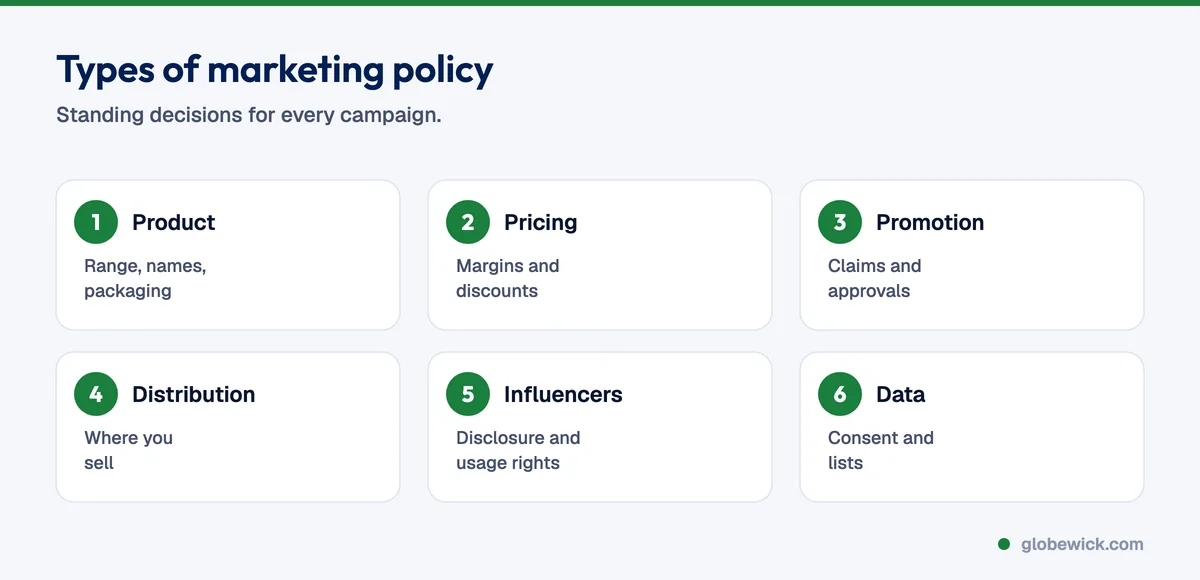
What are the main types of marketing policies?
1. Product policy
Decides which products you sell, how they are named and described, how the range grows, and what happens to slow sellers. It also sets rules for packaging, labelling and product photography. For D2C brands it should cover what to do when a hero product goes out of stock. See what to do when your best-selling product goes out of stock.
2. Pricing and discount policy
Sets your pricing method (cost plus, value based, competitive), minimum margins, the maximum discount allowed, how often sales run, and whether codes can stack. Without this, every campaign drifts towards bigger discounts. Our guide on pricing products for profitable paid acquisition explains the maths.
3. Promotion and advertising policy
Covers which channels you use, what claims are allowed, the evidence needed for each claim, how competitors may be mentioned, and who approves ads before they go live.
4. Distribution and channel policy
Decides where you sell (own website, marketplaces, quick commerce, retail, distributors) and the rules for each, such as minimum advertised prices and whether resellers can run ads on your brand name.
5. Influencer and endorsement policy
Sets how creators are chosen, what they are paid, how sponsored posts are disclosed, who owns the content and whether you can run it as ads. See what to ask before you sign a creator.
6. Data and privacy policy
Explains what customer data you collect, how consent is captured, how long data is kept, and how it is used for email, WhatsApp, retargeting and customer list uploads to ad platforms.
7. Social media and communication policy
Who can post on brand accounts, response times for comments and messages, how complaints are handled publicly, and what employees may say about the company online.
What laws shape marketing policies in India?
Indian brands should build policies around these rules. This is a practical summary, not legal advice, so check with a lawyer for your category.
- Consumer Protection Act, 2019: bans misleading advertisements and lets the Central Consumer Protection Authority (CCPA) act against brands and endorsers.
- CCPA guidelines on misleading advertisements and endorsements, 2022: rules on free claims, surrogate ads, children's ads and disclosure by endorsers.
- Guidelines on dark patterns, 2023: ban practices such as false urgency, basket sneaking, confirm shaming and hidden costs. Countdown timers and "only 2 left" banners must be true.
- ASCI code and influencer guidelines: the Advertising Standards Council of India requires clear labels such as #ad or #collab on paid creator content, and evidence for claims.
- Category rules: health, food, supplements, cosmetics and financial products have extra rules from regulators such as FSSAI, CDSCO and SEBI on what can be claimed.
- Digital Personal Data Protection Act, 2023: sets consent and data handling duties for customer data as its rules come into force.
What rules apply in the US, UK and other markets?
| Market | Main rules | Key points for marketers |
|---|---|---|
| United States | FTC Act, FTC Endorsement Guides, CAN-SPAM | Claims need evidence, sponsored posts need clear disclosure, fake reviews are banned, email needs an unsubscribe |
| United Kingdom | CAP Code (ASA), consumer protection law, UK GDPR, PECR | Ads must not mislead, influencer ads labelled, opt-in consent for marketing email |
| European Union | Unfair Commercial Practices Directive, GDPR, Digital Services Act | Clear pricing and discount rules, consent for tracking and email |
| Australia | Australian Consumer Law, Spam Act, AANA codes | No misleading claims or fake urgency, consent for commercial email |
If you sell across borders, your policy should follow the strictest market you sell into, or set clear differences per market.
How do ad platform policies fit in?
Meta and Google have their own advertising policies, and they are often stricter than the law. An ad can be legal and still get rejected. From the accounts we manage, these areas cause the most rejections and restrictions:
- Health, fitness and supplements: no before and after images that imply guaranteed results, no claims about curing or treating conditions, no wording that points at a person's body or health ("Are you overweight?").
- Personal attributes: Meta does not allow ad copy that asserts or implies someone's health, finances, religion or other personal traits.
- Special ad categories: housing, employment, credit and financial products have limited targeting on Meta and extra verification on Google.
- Landing pages: the page must match the ad, load properly and show clear business details. Misleading pages lead to account bans, not just ad rejections.
- Healthcare: Google requires certification for some healthcare and pharmacy advertising in many countries.
Put a short platform section in your policy so creative teams avoid these patterns from the start. Our guide on briefing a creative team shows where to add it.
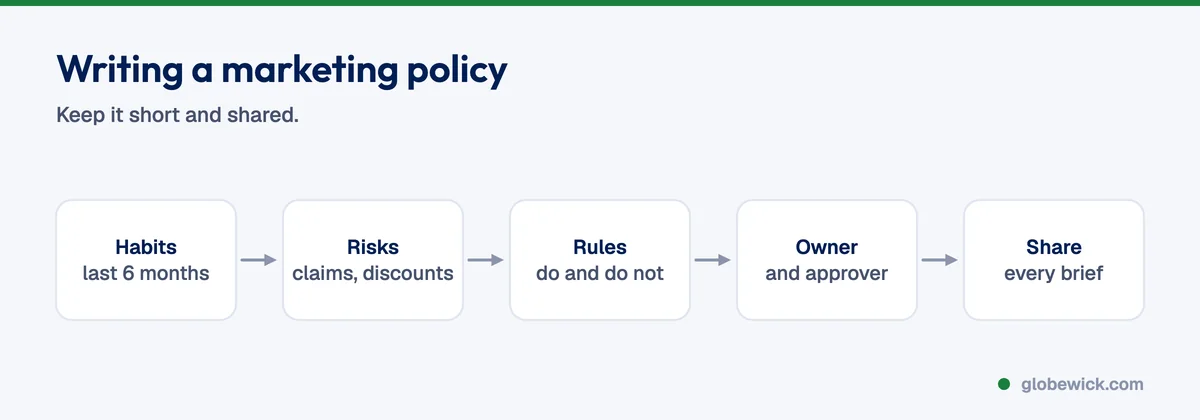
How do you write a marketing policy?
- List your current habits. Look at the last six months of campaigns: discounts used, claims made, creators hired, channels run. Many policies already exist informally.
- Find the risks. Which claims could not be proven? Which discounts hurt margin? Which ads were rejected? Which complaints came up?
- Write short rules. One page per area, written as simple do and do not lines, with examples.
- Name an owner and an approver. Someone keeps the policy updated, and someone signs off on anything that breaks it.
- Share and train. Give the policy to every agency, freelancer and creator you work with, and include it in every brief.
- Review every six months, and whenever a law, platform rule or product line changes.
A simple marketing policy template
| Section | What to write |
|---|---|
| Purpose and owner | Why the policy exists and who maintains it |
| Brand and voice | Tone, words to use and avoid, visual rules. See building a brand voice |
| Claims | Allowed claims, the evidence held for each, banned phrases |
| Pricing and offers | Maximum discount, sale calendar, code stacking, free shipping rules |
| Urgency and scarcity | Only real deadlines and real stock levels |
| Influencers and reviews | Disclosure labels, usage rights, no paid or fake reviews |
| Data and consent | How consent is captured, list hygiene, customer list uploads |
| Channels | Approved channels and platform policy notes for each |
| Approvals | Who signs off ads, emails and creator posts, and how fast |
| Breaches | What happens if a rule is broken and how to fix it publicly |
Marketing policy examples by niche
- Supplements: "We never say our products treat, cure or prevent any condition. Every benefit claim links to a study we hold on file."
- Fashion: "Site-wide sales run at most four times a year. Discounts never exceed the level set by finance."
- Healthcare clinics: "Patient photos are used only with written consent and never in a way that implies guaranteed results."
- D2C food: "Nutrition and ingredient claims match the label exactly."
- Beauty: "Creators label every paid post and every gifted product post."
Need ads that perform and stay inside platform rules in sensitive niches like health and supplements? See our Meta ads agency page.
FAQs
What are the 4 marketing policies?
In marketing mix terms, they are product policy, pricing policy, promotion policy and distribution (place) policy. Modern businesses add data, influencer and social media policies.
Why does a business need a marketing policy?
To keep campaigns consistent, avoid legal and platform trouble, protect margins from constant discounting and help teams work faster without asking for approval on every decision.
Who should write the marketing policy?
Usually the marketing head with input from finance (pricing), legal or compliance (claims and data) and customer support (complaints). Agencies should follow it, not write it alone.
Do influencers in India have to disclose paid posts?
Yes. ASCI guidelines and CCPA endorsement rules require clear disclosure such as #ad, #collab or #sponsored on paid or gifted content.
How often should marketing policies be updated?
Review them at least every six months, and immediately after a change in law, a platform policy update, a new product category or an ad account restriction.
Is a privacy policy the same as a marketing policy?
No. A privacy policy is a public document telling customers how you handle their data. A marketing policy is an internal rulebook. The data section of your marketing policy should match your privacy policy.