 GLOBEWICK
What Is Performance Marketing? Meaning, Metrics and Channels
Performance marketing is advertising where you pay for, measure and optimise towards a specific result, such as a lead, a sale or an app install, rather than just reach or impressions. Google Ads, Meta ads, TikTok ads, affiliate programmes and shopping ads are the most common performance channels. Every dollar is tracked to an outcome, so you can see your cost per lead, cost per sale and return on ad spend, and move budget to whatever works. This guide explains how performance marketing works, the metrics that matter, the main channels and how to tell if it is right for your business.
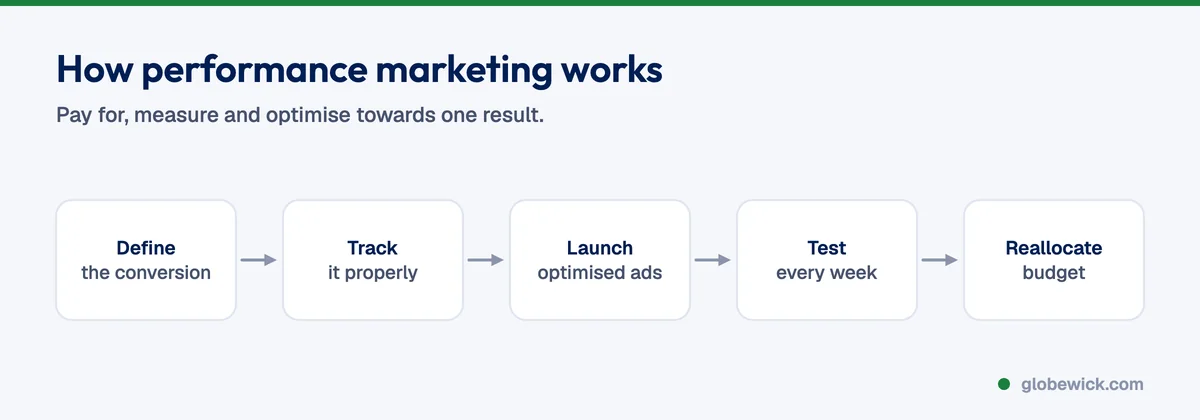
How performance marketing works
Traditional brand advertising, like a billboard or a TV spot, is bought on reach and judged on awareness. Performance marketing flips that. You decide the action you want, track it accurately, and let the ad platforms and your own optimisation chase that action at the lowest cost.
- Define the conversion. A purchase, a booked call, a quote request or a qualified lead.
- Track it properly. Install the Meta Pixel and Conversions API, Google tags and enhanced conversions, and connect your CRM where leads become customers.
- Launch campaigns optimised for that conversion. Platforms use the conversion data to find more people like those who converted.
- Test continuously. New creative, offers, audiences and landing pages every week.
- Move budget to what works. Scale the campaigns with the best cost per result and cut the rest.
Key performance marketing metrics
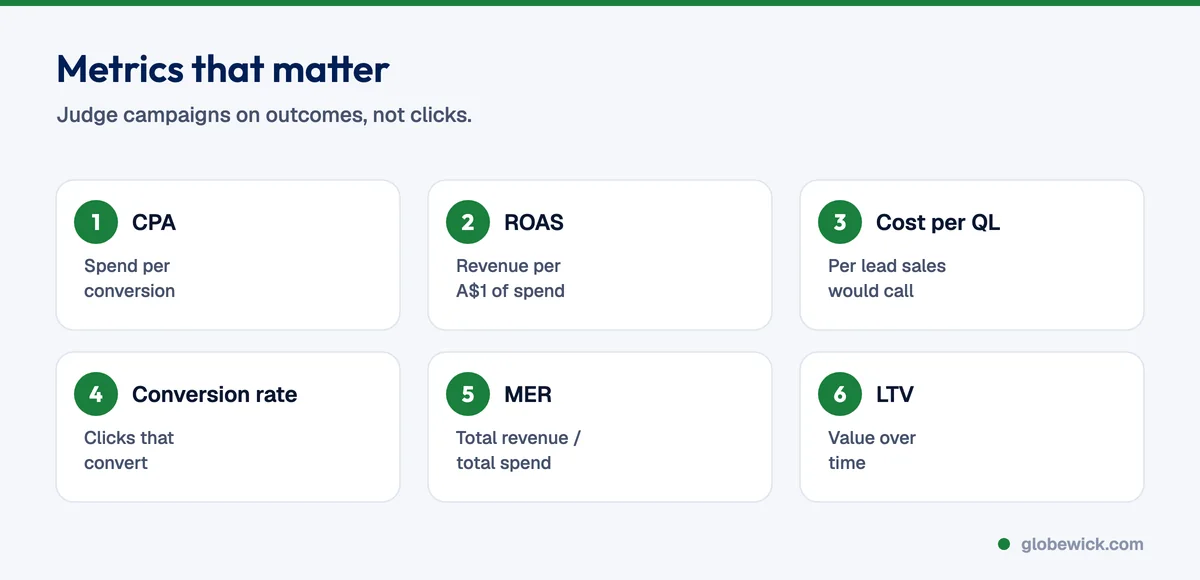
- CPA (cost per acquisition): ad spend divided by conversions. The core efficiency number.
- ROAS (return on ad spend): revenue from ads divided by ad spend. A ROAS of 4 means A$4 of revenue for every A$1 spent. See our guide to what a good ROAS is.
- CPL and cost per qualified lead: for service businesses, the cost of a lead your sales team would actually call back.
- Conversion rate: the share of clicks that turn into a lead or sale. Often the cheapest lever to improve.
- MER (marketing efficiency ratio): total revenue divided by total marketing spend. A useful check when platforms over-claim credit.
- Customer lifetime value: what a customer is worth over time, which tells you how much you can afford to pay for the first sale.
The main performance marketing channels
- Google Search ads: capture people already searching for what you sell. Strong for services and high-intent products.
- Google Shopping and Performance Max: product ads across Search, Shopping, YouTube and more, driven by your product feed.
- Meta ads (Facebook and Instagram): create demand with video and images shown to people likely to buy. Strong for ecommerce, local services and lead generation.
- TikTok ads: short-form video reaching younger and fast-growing audiences.
- LinkedIn ads: B2B targeting by job title, seniority and company.
- Affiliate and marketplace ads: pay commissions or bid for placement on platforms where buyers already shop.
Performance marketing vs brand marketing
They work best together. Brand marketing makes people recognise and trust you, which lifts the conversion rate of every performance campaign. Performance marketing turns that trust into measurable sales. A brand that only runs performance ads often finds costs rising as it exhausts the people who already wanted to buy. A brand that only runs awareness has no clear idea what its spend returns.
Is performance marketing right for your business?
It usually works well when:
- You can track the result online, or connect offline sales back to ads.
- You know your margins and what you can afford to pay for a customer.
- Your website or landing page converts visitors reliably.
- You can commit to at least two to three months of testing.
It struggles when the product is unclear, the website is slow or confusing, or the budget is too small to collect enough data. Fix those first.
Common mistakes
- Judging campaigns on clicks or platform ROAS without checking real revenue.
- Broken tracking that counts page views as conversions.
- Scaling budget faster than creative and offers can keep up.
- Running the same few ads for months until performance collapses.
- Optimising for the cheapest lead rather than the lead most likely to buy.
Performance marketing agencies
A good performance marketing agency should set up tracking first, report on revenue and cost per customer, test creative every week and explain every budget change. Globewick has managed more than US$15M in Meta and Google ad spend for brands in India, Australia, the US, the UK and the UAE. See our services or our page for Australian businesses.
FAQ
What is the difference between performance marketing and digital marketing?
Digital marketing covers all online marketing, including SEO, content, email and social. Performance marketing is the part where you pay for and optimise towards measurable results, mostly through paid ads.
Is SEO performance marketing?
Not in the strict sense, because you do not pay per result. But SEO can and should be measured on leads and revenue, and it lowers your blended cost per customer over time.
How long does performance marketing take to work?
Ads can bring results within days, but most accounts need four to eight weeks of testing before costs settle and scaling decisions are reliable.