 GLOBEWICK
Word of Mouth Marketing: How to Get Customers Recommending You
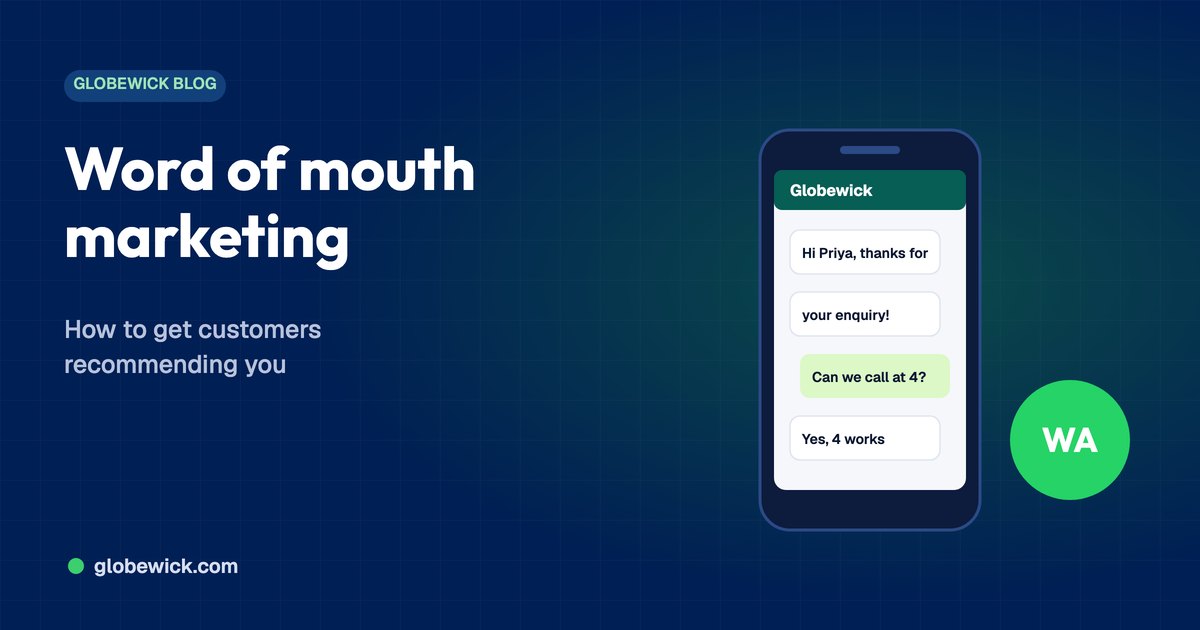
Word of mouth marketing is getting customers to recommend you to other people, in person, on WhatsApp, in reviews or on social media. You cannot buy it directly, but you can cause more of it: deliver a product worth talking about, make sharing easy, reward referrals, and put existing recommendations in front of new buyers through reviews and ads.
"Word of mouth marketing" was searched 1,000 to 10,000 times a month in the United States and 100 to 1,000 times a month in India, according to Google Ads Keyword Planner data we pulled in November 2026. The broader term "word of mouth" sits in the 10,000 to 100,000 band in both markets, although much of that is people looking up the phrase itself.
Most of the brands we work with, from D2C food and beauty to fitness studios and clinics, already get some referrals. The difference between the ones that grow fast and the rest is usually whether they treat word of mouth as a system or as luck. This guide shows how to build that system.
What is word of mouth marketing?
Word of mouth marketing is any effort to get people talking about your business to others. The talking itself is organic: a friend telling a friend which skincare brand cleared her skin, a colleague sharing the name of the physiotherapist who fixed his back. The marketing part is everything you do to make that happen more often, reach more people, and be easy to act on.
It includes both offline talk and online versions of it: Google reviews, product reviews, unboxing videos, Instagram tags, WhatsApp forwards, community posts and creator recommendations. In marketing terms, it sits in earned media, the attention other people give you. Our post on paid, owned and earned media explains how it fits with the rest.
Why does word of mouth work so well?
- Trust. A recommendation from someone you know carries more weight than any ad, because the person has nothing to gain from lying.
- Pre-qualified buyers. People recommend you to friends with the same problem, budget and taste, so referred customers tend to convert faster.
- Lower acquisition cost. A referral costs a reward at most, compared with the full cost of paid acquisition.
- Compounding. Referred customers are often loyal and refer others in turn.
The catch is that it is slow and hard to control on its own. That is why most growing brands combine it with paid acquisition: ads bring the first buyers, and word of mouth multiplies them.
What are the types of word of mouth marketing?
| Type | What it looks like | Best for |
|---|---|---|
| Organic recommendations | Happy customers tell others without being asked | Every business, if the product is good |
| Referral programmes | Give and get rewards for introducing a friend | D2C, subscriptions, apps, fitness, clinics |
| Reviews and ratings | Google, marketplace and on-site reviews | Local businesses, ecommerce |
| User generated content | Customers post photos, reels and unboxings | Fashion, beauty, food, home |
| Creator and influencer seeding | Sending products to creators who share honest views | Consumer brands launching or entering a new market |
| Community | Groups, events and clubs around the brand | Fitness, hobbies, education, B2B |
| Brand advocates and ambassadors | Loyal customers given early access or perks | Brands with a passionate core audience |
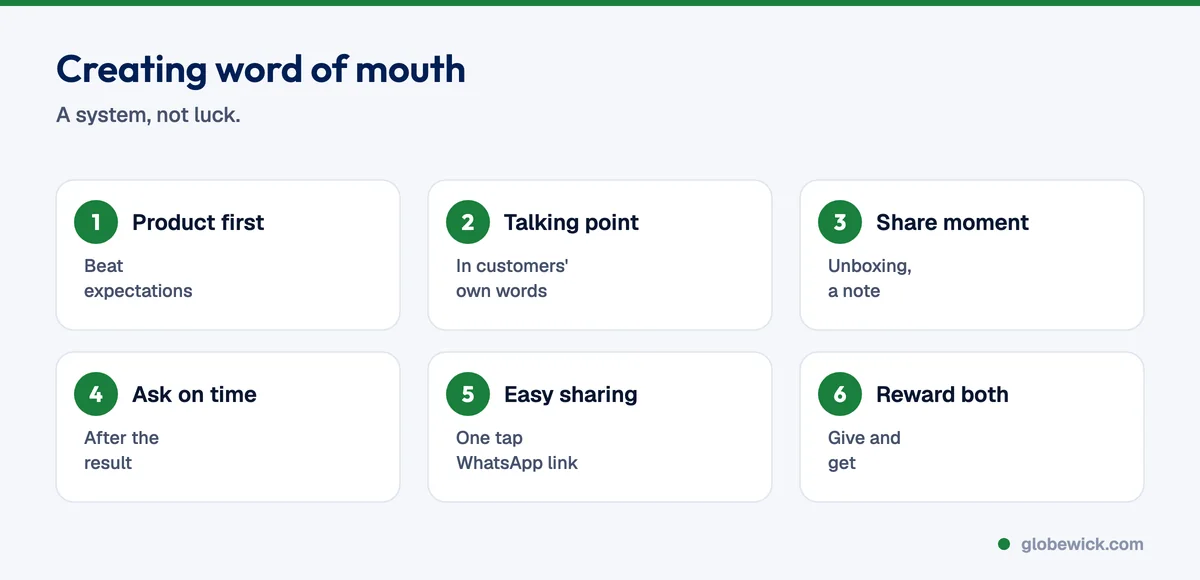
How do you create word of mouth for your business, step by step?
- Fix the product and experience first. People only recommend things that beat their expectations. Look at reviews, returns and support tickets to find what disappoints people, and fix it before asking for referrals.
- Find your talking point. What do happy customers say in their own words? It might be a result, a flavour, the packaging, or how fast you replied. Build that into the product and the message.
- Design a moment worth sharing. A memorable unboxing, a handwritten note, a free sample of a second product, a follow-up call from the doctor. See packaging and unboxing as a retention lever.
- Ask at the right time. Ask for a review or referral just after the customer has experienced the result, not at checkout. For a skincare brand that might be three weeks after delivery. For a service, right after a good session.
- Make sharing easy. A one-tap review link, a referral link that works on WhatsApp, a ready-to-forward message with a code.
- Reward both sides. A give and get referral reward, such as a discount for the friend and credit for the referrer, usually beats a reward for only one side.
- Amplify what people say. Use reviews and customer videos in ads, on product pages and in emails, so the recommendation reaches people who do not know your customers.
- Track it. Referral codes, "how did you hear about us" questions and review counts turn word of mouth into numbers you can manage.
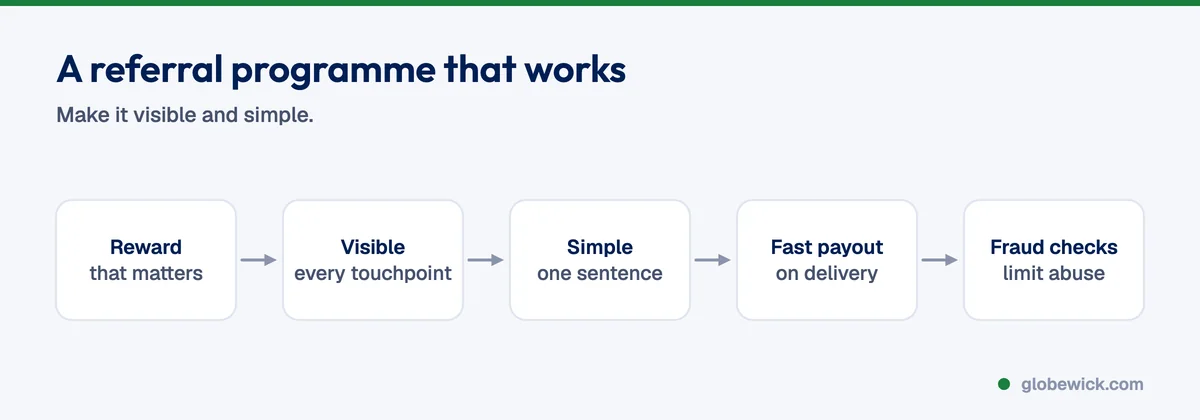
How do you set up a referral programme that people actually use?
Most referral programmes fail because nobody knows they exist. The ones that work in our client accounts have a few things in common:
- A reward that matters to the customer, sized against your margins. Store credit often costs you less than cash and brings the referrer back.
- Visibility everywhere: the order confirmation page, the shipping email, a card in the box, the account page and a WhatsApp message after delivery.
- Simple rules: one sentence explaining what both people get.
- Fast payout: credit the referrer as soon as the friend's order is delivered, not months later.
- Fraud checks: limit self-referrals and repeated codes, especially for cash on delivery orders.
Shopify apps and most email and SMS platforms can run referral flows. Our post on email and SMS flows every D2C store should have shows where the referral ask fits in a post-purchase sequence.
What are good word of mouth marketing examples?
A few patterns we see repeatedly in the categories we work in:
- D2C food: a sampler box with a small extra pack labelled "for a friend" turns each order into a trial for someone new.
- Beauty and skincare: asking customers to share a before and after at day 30, with a reward for posting, creates both proof and reach.
- Fitness studios: a free guest pass each month for members, plus a group challenge that members invite friends to join.
- Healthcare and clinics: a follow-up message after the visit with a direct Google review link, which builds both trust and local rankings.
- Fashion: tagging the brand on Instagram for a chance to be featured, so customers become the brand's lookbook.
None of these are complicated. They work because they are built into the normal customer journey rather than run as a one-off campaign.
How does word of mouth work online?
Online, word of mouth becomes visible and searchable. That makes it more powerful, and it also means you can influence how many people see it:
- Google reviews shape whether you appear in local results and whether searchers click. Our Google Business Profile guide covers how to earn them steadily.
- Social proof in ads. Ads built from real customer reviews and videos often beat polished brand ads on Meta. They are word of mouth at paid scale.
- Creators. A creator's honest recommendation works like word of mouth from a trusted friend, as long as the fit is real. See our influencer marketing guide.
- Communities. Brand groups and active comment sections turn customers into helpers for each other.
- AI answers. Reviews, forum threads and lists that mention your brand are increasingly what AI assistants draw on when someone asks for a recommendation.
How do you measure word of mouth marketing?
- Referral orders and revenue from codes and links.
- "How did you hear about us?" as a short post-purchase question. Friend or family answers are your word of mouth share.
- Review count and rating on Google and your store, tracked monthly.
- Branded search volume in Search Console, which rises when people talk about you.
- Repeat purchase rate, because loyal customers are the ones who recommend. See why repeat purchase rate matters.
- Net Promoter Score, if you survey customers, as a simple read on willingness to recommend.
What are the common mistakes with word of mouth marketing?
- Asking for referrals before the product has delivered its result.
- Buying fake reviews, which breaks platform rules and destroys trust when found.
- Hiding the referral programme in a footer link.
- Rewards so small nobody bothers, or so large they attract fraud.
- Ignoring negative reviews instead of replying and fixing the cause.
- Treating word of mouth as a replacement for paid acquisition, instead of a multiplier on it.
Want help building the paid and retention side that feeds word of mouth? See our ecommerce growth services and social media marketing services.
FAQs
What is an example of word of mouth marketing?
A referral programme where a customer shares a link with a friend, the friend gets a discount on their first order and the customer gets store credit, is a common example. So is asking happy customers to leave a Google review.
Is word of mouth marketing free?
The recommendations are free, but creating them is not. You pay through product quality, referral rewards, samples, packaging and the time spent asking for reviews.
Is word of mouth still effective in digital marketing?
Yes. It has moved online into reviews, social posts, creator content and messaging apps, which makes it easier to spread and easier to measure.
How do small businesses get more word of mouth?
Deliver one thing noticeably better than competitors, ask for a review or referral at the moment customers are happiest, and make sharing a one-tap action on WhatsApp or by link.
What is the difference between word of mouth and referral marketing?
Word of mouth is any recommendation, asked for or not. Referral marketing is a structured part of it, where you track and usually reward the introductions.