 GLOBEWICK
Media in Marketing: Paid, Owned and Earned Media Explained
Media in marketing means every channel a brand uses to reach people: paid media you buy (Meta, Google and YouTube ads), owned media you control (your website, email list, WhatsApp and social profiles) and earned media other people create about you (reviews, press, creator posts and word of mouth). Good media marketing plans all three together, so each one makes the others cheaper.
"Media marketing" was searched 1,000 to 10,000 times a month in both India and the United States, and related terms such as "paid media marketing", "new media marketing" and "media mix marketing" were each searched 100 to 1,000 times a month, according to Google Ads Keyword Planner data we pulled in November 2026.
What does media mean in marketing?
In marketing, "media" is the space where your message appears. It used to mean newspapers, TV, radio and outdoor hoardings. Today most of the budget we see goes into digital media: social feeds, search results, video platforms, marketplaces, inboxes and chat apps. The question a media plan answers is simple: where will the right people see us, how often, and what will it cost to reach them?
Media is different from the message. The creative (the ad, the post, the email) is what people see. The media is where and how they see it. A strong ad on the wrong media wastes money, and a weak ad on the right media still underperforms. You need both. If you are new to the wider picture, start with what digital marketing is and come back here.
What are paid, owned and earned media?
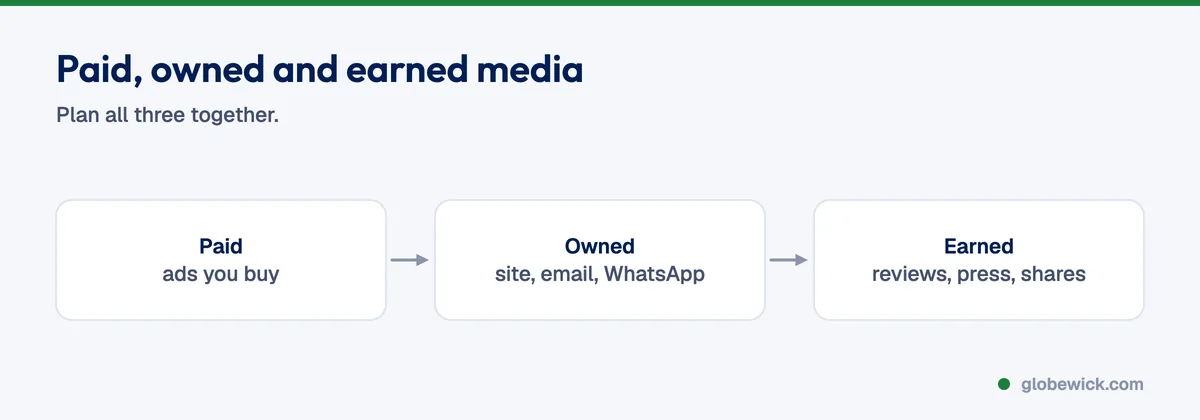
Almost every media plan is built from three types. Marketers often call this the POE model.
| Type | What it is | Examples | Strength | Weakness |
|---|---|---|---|---|
| Paid media | Reach you buy | Meta ads, Google Search and Shopping, YouTube, marketplace ads, programmatic display, influencer fees | Fast, scalable, precise targeting | Stops the day you stop paying; costs rise with competition |
| Owned media | Channels you control | Website, blog, email list, WhatsApp broadcast list, app, organic social profiles | Cheap to reuse, builds over time, you own the data | Slow to grow without paid or earned support |
| Earned media | Attention others give you | Reviews, press mentions, shares, unpaid creator content, referrals, organic search rankings | Most trusted by buyers | Hard to control or predict |
Some teams add a fourth type, shared media, for social content that is both owned (you post it) and earned (others share and comment). It is a useful label, but the planning logic stays the same.
How do paid, owned and earned media work together?
The three types feed each other. This is the part most small businesses miss when they treat ads, SEO and social as separate projects.
- Paid builds owned: a Meta lead ad or a Google Search campaign brings people to your site, and a share of them join your email or WhatsApp list. You paid once, and you can now reach them again for close to nothing.
- Owned earns more: a useful guide on your blog gets linked by other sites, which is earned media, and those links help your rankings. Our link building guide covers how that works.
- Earned makes paid cheaper: reviews, ratings and real customer videos used inside ads lift click-through and conversion rates. Social proof in a Meta ad is one of the most reliable ways we have seen to bring the cost per purchase down for D2C food, beauty and supplement brands.
- Paid tests what to own: run three angles as ads for a week, see which one wins, then turn the winner into a landing page, an email and an SEO article.
What is paid media marketing?
Paid media marketing is buying placements to reach a defined audience. In 2026 for most brands that means a short list:
- Meta (Facebook and Instagram): best for creating demand, visual products, D2C and lead generation. See how to structure a Meta ads account.
- Google Search and Shopping: best for capturing demand from people already searching.
- YouTube and Performance Max: video reach plus Google's automated placements across its network.
- Marketplace ads: Amazon, Flipkart, Nykaa and quick commerce apps in India, Amazon and Walmart in the US.
- LinkedIn: B2B targeting by job title and company, at a higher cost per click.
- Paid creator partnerships: paying influencers to post, then often running their content as ads.
Paid media is measured on results: cost per lead, cost per purchase, return on ad spend. If you are still deciding whether a post boost is enough, read when to boost a post vs run a proper paid campaign.
What is organic media marketing?
Organic media marketing is the unpaid side: SEO, organic social posts, email, community, PR and word of mouth. It covers both owned and earned media. It is slower than paid, but the results compound. An article that ranks keeps bringing visitors for years, and an email list keeps producing sales from people you already paid to acquire once.
For most clients we work with, organic does two jobs. It lowers blended acquisition cost over time, and it gives paid media better assets to work with: proven content, retargeting audiences and real reviews.
What is new media and cross media marketing?
New media marketing is an older term for digital, interactive channels (social networks, video platforms, podcasts, apps and messaging) as opposed to print, TV and radio. Today "new media" mostly means the channels that moved fastest recently: short-form video, creator content, AI search answers and chat commerce on WhatsApp.
Cross media marketing means running one campaign across several media at once with a shared message, so a person who sees your Reel, then searches your brand, then gets your email meets one consistent story. The practical rules:
- One core message and offer per campaign.
- Adapt the format to each channel, not the message.
- Use the same tracking (UTM parameters, one analytics setup) so you can see the path.
- Sequence it: awareness on video, consideration through retargeting and search, conversion through email and WhatsApp.
What is rich media and online media marketing?
Rich media is any ad or content with interactive or moving elements: video, carousels, playable ads, polls, instant experiences on Meta and expandable display banners. Rich media usually earns more attention than a static image, but costs more to produce. Online media marketing is simply the umbrella for all of this in digital channels.
For most small and mid-sized brands, the best value rich media is plain short video shot on a phone: a founder explaining the product, a customer unboxing it, a before and after. See what is working in short-form video right now.
How do you build a media mix?
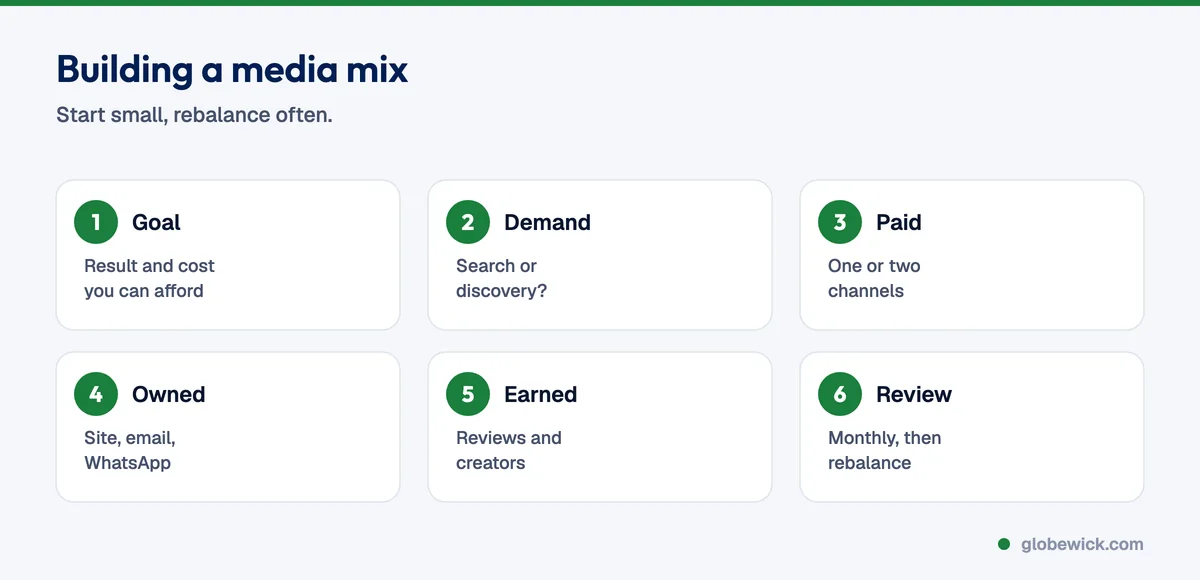
Media mix marketing means deciding how much budget and effort goes into each channel. This is the process we use with new clients.
- Start with the goal and the number. Sales, leads or app installs, and the cost per result you can afford. Our guide on setting a realistic CPA target walks through the maths.
- Check where demand already exists. If people search for what you sell, Google Search comes first. If they do not know they need it yet, Meta and video come first.
- Pick one or two paid channels, not five. Spreading a small budget across many platforms means none of them gets enough data to optimise.
- Set up owned media before you scale paid. A fast landing page, email or WhatsApp capture and basic automation. Without these, every paid visitor who does not buy is lost.
- Plan for earned media. Ask every customer for a review, give creators product, and make sharing easy.
- Review monthly, rebalance quarterly. Move money towards the channel with the best marginal return, not the best average.
A rough starting split we often see working for D2C brands in their first year is most of the paid budget on Meta, a smaller share on Google Search and Shopping for brand and product terms, and steady time on email, WhatsApp and SEO. For B2B lead generation, Google Search and LinkedIn usually lead. This is a starting point, not a rule. Read choosing the right marketing channel for your business stage for more detail.
How do you measure media ROI?
Media ROI is the profit a channel produces compared with what you spent on it. Measuring it well is harder than it sounds, because platforms each claim credit for the same sale.
- Use blended numbers first: total revenue divided by total marketing spend (often called MER), and total new customers divided by total spend.
- Then look at each channel with a consistent attribution window. See why your ad platform and analytics disagree.
- Run holdout tests when spend is large enough: pause a channel in one region or for one audience and see how much total sales drop.
- Count owned and earned value too: growth in email subscribers, branded search volume, reviews and organic traffic.
What goes into a media proposal?
If you are hiring an agency or pitching a plan internally, a useful media proposal answers these questions on one or two pages:
- The business goal and the target cost per result.
- Who the audience is and where they spend time.
- Which channels, with the budget for each and why.
- The creative needed for each channel and who makes it.
- How results will be tracked and reported, and how often.
- What happens in month one (testing) versus month three (scaling).
Be wary of proposals that promise fixed results before any testing, or that spread a small budget across every platform. Our guide on how to choose a performance marketing agency lists more red flags.
Media marketing in India vs global markets
The principles are the same everywhere, but the channel mix shifts. In India, WhatsApp is often the strongest owned channel, cash on delivery shapes how D2C campaigns are measured, and Meta and YouTube reach is very large at a lower cost per thousand impressions than in the US, UK or Australia. In the US and other English-speaking markets, email is still the stronger owned channel, Google Shopping is more competitive, and costs per click are higher, so conversion rate work matters even more. When we run campaigns for brands selling into several countries, we plan media by market rather than copying one plan across all of them.
Want help planning and running paid media that feeds the rest of your marketing? See our Meta ads agency page or the full list of Globewick services.
FAQs
What is media in marketing in simple words?
It is the set of places where your marketing message appears, such as ads, your website, social profiles, email and what others say about you online.
What is the difference between paid media and earned media?
Paid media is reach you buy, such as ads. Earned media is attention you do not pay for directly, such as reviews, press coverage, shares and organic rankings.
Which media is best for a small business?
Usually one paid channel that matches how your customers buy (Google Search if they search, Meta if they discover), plus owned media such as a good website and an email or WhatsApp list, plus a habit of collecting reviews.
What is a media mix?
A media mix is how your budget and effort are split across channels. It should change as you learn which channels bring customers at the best cost.
Is social media paid or owned media?
Both. Your profile and organic posts are owned media, ads on the platform are paid media, and shares, tags and comments from others are earned media.
How do you calculate media ROI?
Take the profit generated by a channel, subtract what you spent on it, and divide by the spend. Use blended totals alongside platform numbers, because each platform tends to over-credit itself.