 GLOBEWICK
Guerilla Marketing: Types, Examples and How to Plan One
Guerilla marketing is low-cost, unconventional promotion that surprises people in places they do not expect advertising, such as streets, events, packaging or social feeds, so they talk about it and share it. It works when the idea is simple, tied to the product and easy to photograph, and when you have a plan to turn the attention into sales.
"Guerilla marketing" was searched 1,000 to 10,000 times a month in both India and the United States, according to Google Ads Keyword Planner data we pulled in November 2026, with the correct spelling "guerrilla marketing" in a similar band. Example searches such as "Nike guerilla marketing" and "viral guerilla marketing" sit lower, mostly in the 10 to 100 band.
We are a performance agency, so we look at guerilla tactics with one question: does the stunt lead to measurable demand? Sometimes it does, especially for local businesses and D2C launches, when the offline moment is filmed and pushed out through paid social. This guide covers the types, examples, how to plan one and how to measure it.
What is guerilla marketing?
The term was popularised by Jay Conrad Levinson in his 1984 book Guerrilla Marketing, written for small businesses that could not match big brands' ad budgets. The idea borrows from guerrilla warfare: small, surprising, well-aimed actions instead of large conventional campaigns.
In practice, guerilla marketing covers street art and installations, pop-up experiences, flash mobs, stickers and chalk, ambush marketing around big events, and stunts designed to be filmed. Today most guerilla ideas are planned with the social video in mind. The physical stunt might reach a few hundred people, and the video of it reaches far more.
Is guerilla marketing still relevant in digital marketing?
Yes, but its job has changed. Twenty years ago a clever street installation spread through press coverage. Now it spreads through Reels, Shorts and creator posts, and the people who see it are one tap away from your site. That makes guerilla tactics more measurable than before, if you plan for it.
The shift also means a stunt that is not filmed well has wasted most of its value. We now treat the camera crew, the edit and the paid push as part of the stunt, not an afterthought. Our post on what is working in short-form video covers the formats that carry these ideas best.
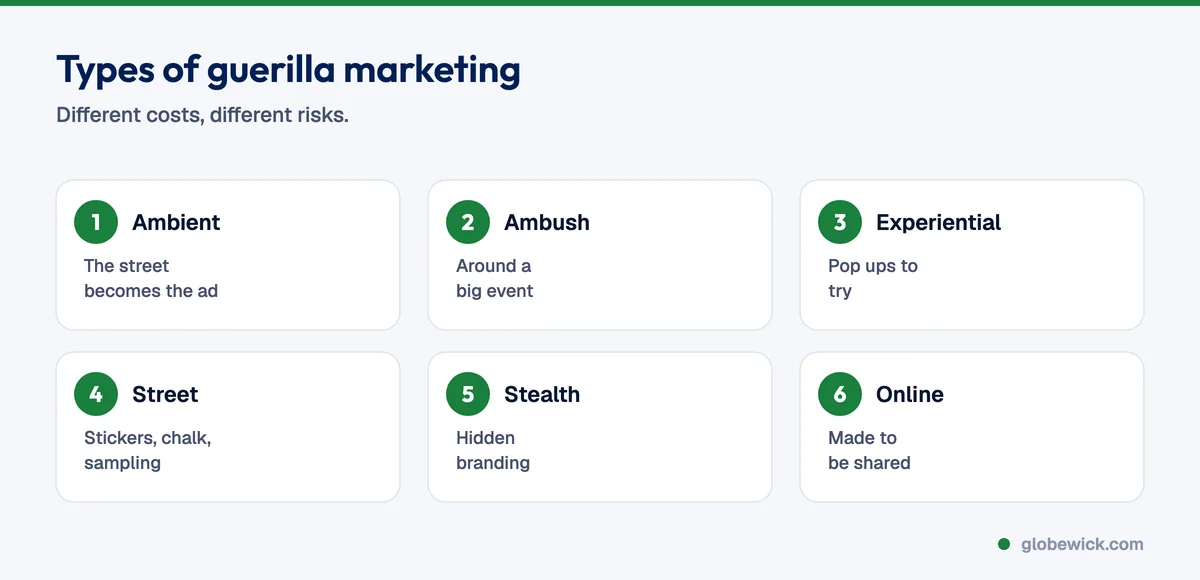
What are the types of guerilla marketing?
| Type | What it is | Typical cost | Risk level |
|---|---|---|---|
| Ambient | Ads placed into the surroundings, such as a bus stop, staircase or bench redesigned around the product | Low to medium | Low, with permission |
| Ambush | Getting attention around a big event without being the official sponsor | Medium | Medium to high, legal limits apply |
| Experiential and pop-up | A short-lived space or activity people can try | Medium to high | Low |
| Street | Stickers, chalk, posters, sampling teams, costumed characters | Low | Medium, depends on local rules |
| Stealth or undercover | Product placed in a situation without obvious branding | Low to medium | High, can feel deceptive |
| Online and viral | Fake-looking ads, surprising filters, interactive posts and stunts made for social | Low | Medium, can be misread |
What are famous guerilla marketing examples?
Nike and ambush marketing
Nike is the brand most often named in "Nike guerilla marketing" searches, mostly for ambush marketing around the Olympics. At the 1996 Atlanta Games, where a rival was the official sponsor, Nike drew attention through athletes, nearby promotion and a striking pair of gold shoes. Around the 2012 London Games, its "Find Your Greatness" campaign featured ordinary athletes in places named London around the world, without using any official Olympic marks. Both show the core ambush idea: own the conversation around an event without paying for the sponsorship.
Ambient ideas that turn the street into the ad
Many celebrated guerilla ideas redesign something people already use: a pedestrian crossing painted to look like a product, a bus stop bench shaped like a sofa from a furniture brand, or a staircase that shows the calories burned on each step for a fitness brand. They work because the product idea is obvious in one glance.
Viral guerilla marketing online
Viral examples usually involve a surprise caught on camera: a hidden camera prank tied to a horror film release, a vending machine that gives away something unexpected, or a "broken" billboard that reveals the product. The ones that last are kind to the people involved. Pranks that frighten or embarrass the public tend to get the wrong kind of attention.
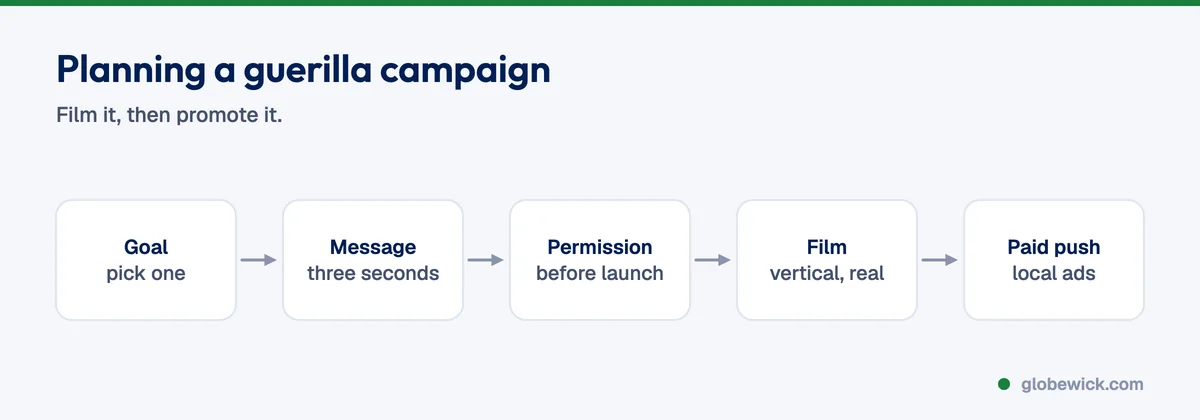
How do you plan a guerilla marketing campaign, step by step?
- Set the business goal. Store visits for a new outlet, app installs in one city, sales for a launch, or followers in a new market. Choose one.
- Pick one simple message. If people cannot understand the idea in three seconds, it will not travel.
- Choose the place and the moment. Where your buyers already gather: a college area, a gym cluster, a market street, a festival, a sports match.
- Get permissions. Local authorities, property owners, event organisers. In India, rules vary between municipal corporations, and many public spaces need prior approval. Rules are similar in spirit in the US, UK and Australia.
- Plan the filming. Several angles, real reactions, vertical framing for Reels and Shorts, and a short edit ready within a day.
- Prepare the follow-through. A landing page, an offer code tied to the stunt, a WhatsApp number or a store ready for extra visitors.
- Put paid behind it. Run the video as ads in the target area for a week or two after the stunt. This is where most of the reach comes from. Our Meta ads playbook for D2C brands covers how to set this up.
- Measure and decide. Compare results with your normal cost per customer to see whether the idea earned its place.
The brief matters as much as the idea. Our guide on briefing a creative team applies just as well to a stunt.
What guerilla marketing ideas work for small businesses?
- Sampling with a twist: a food brand hands out free bites from a branded cart at office lunch hours, with a QR code for a first-order offer.
- Chalk or sticker trails (where permitted) leading from a busy street to a new store.
- Pop-up stalls at gyms, colleges, weddings or flea markets for fitness, beauty and fashion brands.
- Surprise packaging: a message or extra item inside the box that people want to film. It is guerilla marketing that travels with every order.
- Local creator walkabouts: a creator tries your product on the street with strangers, filmed for Reels. See what to ask before you sign a creator.
- Reactive posts: a quick, clever social post tied to a trending moment, shipped the same day.
For more low-cost ideas sorted by goal, see our list of marketing ideas for small businesses.
What are the advantages and disadvantages of guerilla marketing?
| Advantages | Disadvantages |
|---|---|
| Low cost compared with traditional media | Results are unpredictable |
| Memorable and highly shareable | Can break local laws or event rules |
| Builds word of mouth and press interest | Can be misunderstood or cause offence |
| Strong for local launches and new stores | Hard to repeat at scale |
| Creates content you can reuse in ads | Weather, crowds and timing can spoil it |
Is guerilla marketing legal?
It depends on what you do and where. Placing ads on public or private property without permission, blocking footpaths, or using a sponsor's protected event marks can lead to fines, removal or legal claims. Ambush marketing around major events is often restricted by event-specific rules. Stunts that could be mistaken for a real emergency are a serious risk. Always get permission, keep it safe, and run anything sensitive past a lawyer before you launch.
How do you measure guerilla marketing?
- Offer code redemptions and QR scans tied only to the stunt.
- Footfall at the store or stall, compared with a normal week.
- Video views, shares and saves, separating organic reach from paid.
- Branded search in Search Console and Google Trends in the target area.
- Direct traffic and sales from the area in the following two weeks.
- Cost per new customer against your usual paid channels.
Read how to know if your marketing is actually working for a simple way to compare one-off campaigns with always-on activity. To turn a stunt video into ads that run in the right area, see our social media marketing services and Meta ads agency.
FAQs
Is it guerilla or guerrilla marketing?
The original spelling is guerrilla, from Jay Conrad Levinson's book. Guerilla with one r is a common variant, and both are searched widely.
What is the main goal of guerilla marketing?
To get outsized attention from a small budget by surprising people, so they remember the brand and share it.
Which businesses suit guerilla marketing?
Consumer brands with a visual product, local businesses such as cafes, gyms and stores, and launches in a new city tend to get the most from it.
How much does guerilla marketing cost?
Many ideas cost very little in materials. The real costs are permissions, staff, filming, editing and the paid push needed to spread the video.
Can guerilla marketing go wrong?
Yes. Stunts that alarm the public, damage property or mock people can cause fines and backlash. Test the idea on people outside your team before you run it.