 GLOBEWICK
Search Engine Marketing: How SEM Works and How to Run It
Search engine marketing (SEM) is paying to show ads on search engines such as Google and Bing when people search for what you sell. You bid on keywords, write ads, and pay when someone clicks. Because the searcher already wants something, SEM brings some of the highest intent traffic you can buy, and results start the day campaigns go live.
"Search engine marketing" and "SEM" were each searched 1,000 to 10,000 times a month in both India and the United States, and "small business search engine marketing" and "ecommerce search engine marketing" were searched 10 to 100 times a month in each country, according to Google Ads Keyword Planner data we pulled in November 2026.
Most of our Google Ads work for e-commerce, healthcare, fitness and B2B clients is search engine marketing. This guide covers how it works, how to set it up, how to research competitors and what separates accounts that grow from ones that leak money.
What is search engine marketing and how is it different from SEO?
Some people use SEM to mean all search marketing, paid and organic. In day to day agency work, SEM means paid search: Google Ads and Microsoft Advertising (Bing). SEO is the organic side: earning unpaid rankings.
| SEM (paid search) | SEO (organic search) | |
|---|---|---|
| Cost | Pay per click | No click cost, but content and technical work |
| Speed | Traffic from day one | Usually months to build |
| Control | Choose keywords, locations, times, budget | Google decides rankings |
| When it stops | Traffic stops when spend stops | Rankings keep bringing traffic |
| Best for | Testing demand, high intent searches, launches | Long term, lower cost traffic |
The strongest search programmes use both. SEM data on which keywords convert tells your SEO team what to write. For the organic side, read what SEO is, and for the basics of paying per click see our PPC advertising guide.
How does search engine marketing work?
Every time someone searches, Google runs an auction among advertisers bidding on matching keywords. Your position depends on Ad Rank, which combines your bid, the expected click-through rate, the relevance of your ad and the quality of your landing page. A more relevant ad can beat a higher bid, which is why a well organised account often pays less per click than a sloppy one.
The main SEM campaign types in Google Ads are:
- Search campaigns: text ads on keyword searches. The core of SEM.
- Shopping campaigns: product listings with image, price and store name, fed from Google Merchant Center. Essential for e-commerce.
- Performance Max: one campaign that runs across Search, Shopping, YouTube, Display and Maps with heavy automation. Useful, but it needs guardrails. See what you can and cannot control in Performance Max.
How do you set up a search engine marketing campaign?
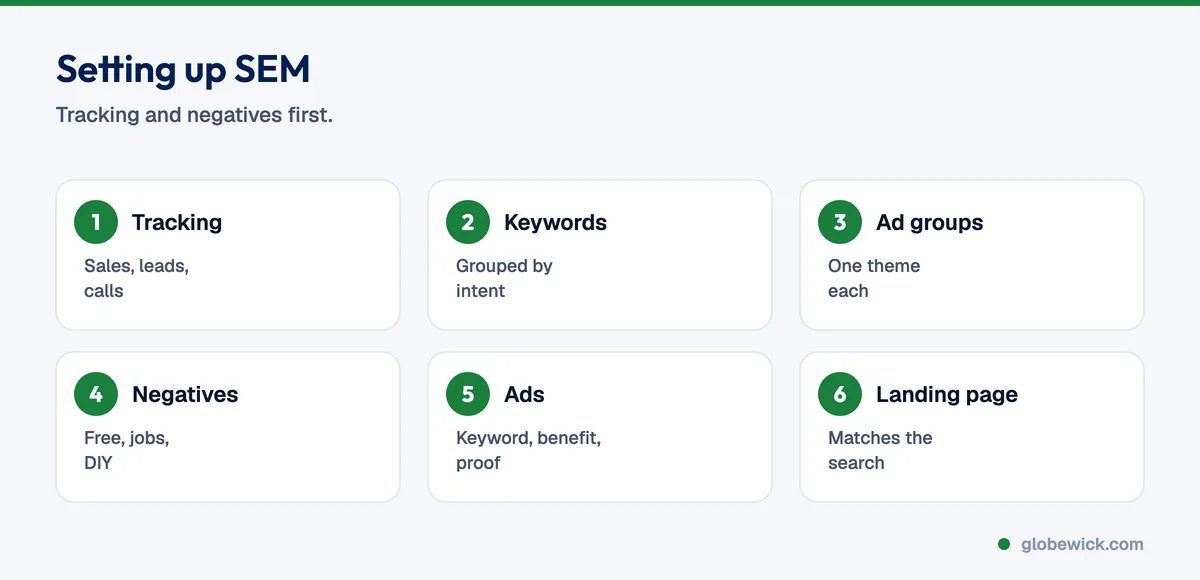
- Set up conversion tracking first. Purchases, form fills, calls and WhatsApp clicks, sent to Google Ads with values where possible. Without it, smart bidding has nothing to learn from.
- Research SEM keywords. Start from what your buyers type, not your product names. Group them by intent: buying ("buy", "price", "near me", "agency"), comparing ("best", "vs", "reviews") and learning ("how to", "what is"). Our keyword research guide covers the process.
- Build tight ad groups. One theme per ad group, so the ad and landing page match the search closely.
- Pick match types. Phrase and exact match for control. Broad match only with smart bidding and plenty of conversion data.
- Add negative keywords. Words such as "free", "jobs", "course", "DIY" and competitor brand names you do not want. Review the search terms report weekly and keep adding.
- Write responsive search ads. Several headlines that include the keyword, the benefit, proof and a call to action. Add sitelinks, callouts and call assets.
- Send clicks to a matching landing page. Not the homepage. One page per service or product category, fast on mobile.
- Choose bidding. Start with Maximise conversions, then move to target CPA or target ROAS once you have steady conversion volume.
- Review weekly. Search terms, wasted spend, ad performance and landing page conversion rate.
How do you do SEM competitor research?
SEM competitor research shows who bids on your keywords, what they say and how hard they push. Three free or low cost places to look:
- Auction insights in Google Ads: who appears alongside you, how often, and how often they rank above you.
- Google Ads Transparency Center: every live ad from a given advertiser, by region.
- Paid SEO and PPC tools: tools such as Semrush and similar platforms estimate the keywords competitors bid on, their ad copy history and rough spend. Semrush's competitor research reports are popular for this, and its team members, including Fernando Angulo, often speak publicly about competitive search research. Treat any tool's spend estimates as directional, not exact.
What to look for: keywords they bid on that you do not, offers in their ads (free shipping, free consultation, price), and landing pages they send traffic to. Then decide where you can win on relevance or offer, rather than simply outbidding.
Search engine marketing for small businesses
Small business search engine marketing works when the budget is focused. A small budget spread across hundreds of keywords produces a few clicks on each and no learning. Instead:
- Choose ten to thirty high intent keywords for your most profitable service or product.
- Target only the locations you serve, with a radius for local businesses.
- Run ads during the hours you can answer calls if calls are your main conversion.
- Add call assets and location assets linked to your Google Business Profile.
- Track every lead back to the keyword, so you know which searches bring paying customers.
"Affordable search engine marketing" is less about a cheap agency and more about not wasting clicks. A tight account on a modest budget usually beats a broad one on a large budget. For cost benchmarks, see Google Ads cost in India and Google Ads cost in Australia.
What does ecommerce search engine marketing look like?
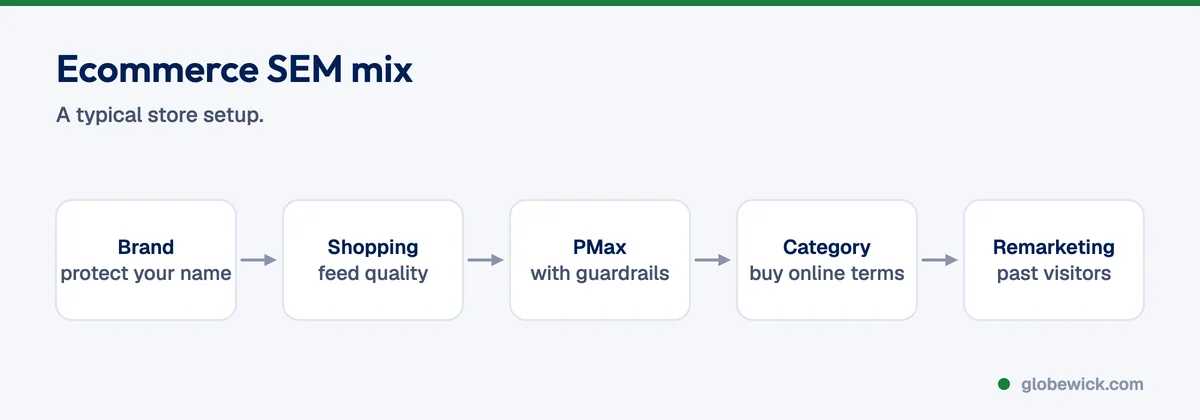
For online stores, Shopping ads usually bring most of the paid search revenue. The quality of your product feed decides how well they work: clear titles with brand, product type, key attributes such as size or colour, accurate prices, good images and correct stock status. We typically run:
- A brand search campaign to protect your own name.
- Shopping or Performance Max split by margin or best sellers.
- Search campaigns for high intent category terms such as "buy [product type] online".
- Remarketing through Performance Max or YouTube for past visitors.
If you sell on Shopify, our Shopify SEO checklist pairs well with this, since feed titles and product page copy help both paid and organic.
What is different about B2B search engine marketing?
B2B search engine marketing has lower search volume, higher cost per click, and a long gap between the click and the sale. Three things matter most:
- Exclude the wrong searchers: students, job seekers and people wanting free versions. Negative keywords do most of this.
- Measure qualified leads, not form fills. Import offline conversions from your CRM so Google bids towards leads that become sales.
- Use landing pages that answer buyer questions: pricing approach, proof, process and a short form.
Our guide on Google Ads for B2B lead generation in India goes deeper.
Can you run search engine marketing on YouTube?
YouTube is the second largest search engine by many measures, and Google Ads can show video ads against YouTube searches and to people who searched related terms on Google. It is not classic SEM, but it captures people researching a purchase. Product demos, comparisons and how-to videos work best here. See our YouTube ads guide.
How do you choose a search engine marketing expert or agency?
Whether you search for "search engine marketing near me" or hire an expert anywhere, check these before you sign:
- You own the Google Ads account and all data, not the agency.
- They talk about cost per qualified lead or profit, not clicks and impressions.
- They show you the search terms report and negative keyword work.
- Reporting is clear and regular, with a named person who knows your account.
- For white label SEM, where an agency resells another team's work, ask who actually runs the account.
Location matters less than it used to. Globewick runs search campaigns for clients in every time zone from our office in Jaipur. See our Google Ads agency services.
FAQs
Is SEM the same as Google Ads?
Google Ads is the biggest SEM platform, so the terms are often used interchangeably. SEM also includes Microsoft Advertising on Bing, and some people include SEO under the wider SEM label.
How much should I spend on search engine marketing?
Work backwards from your target cost per lead or sale and the number of conversions you need. The budget should be enough for at least 20 to 30 clicks a day on your main campaign, so you get data quickly.
How long does SEM take to work?
Ads can bring traffic on day one. Expect two to six weeks of optimisation before cost per conversion settles, as bidding learns and you clean up search terms.
What is SEA in search engine marketing?
SEA stands for search engine advertising, a term common in Europe. It means the same as paid search or SEM in its narrower sense.
Should I do SEO or SEM first?
If you need leads or sales soon, start with SEM while building SEO in the background. SEM also tells you which keywords convert, so your SEO work targets the right ones.