 GLOBEWICK
What Is SEO? Meaning, How It Works and Examples
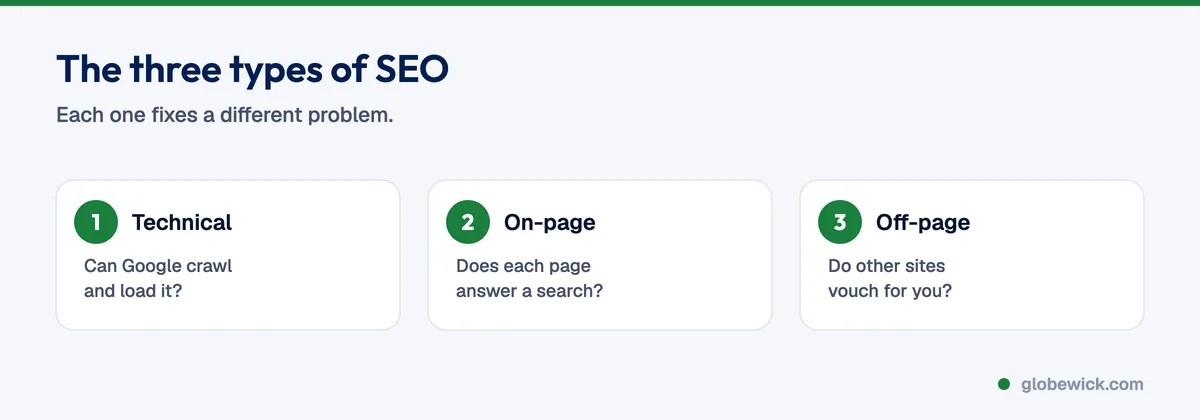
SEO (search engine optimisation) is the work of making your website easier for search engines like Google to find, understand and trust, so it shows up higher in the unpaid results when people search for what you offer. It covers three areas: technical SEO (can Google crawl and load your pages), on-page SEO (does each page clearly answer a search) and off-page SEO (do other sites vouch for you with links and mentions). Unlike ads, you do not pay per click. You invest time or money up front, and good rankings keep sending visitors for months or years.
It is one of the most searched marketing questions on Google. When we checked Google Ads Keyword Planner in November 2026, "seo meaning" and close variants such as "define seo" were each searched 10,000 to 100,000 times a month in both India and the United States, and 1,000 to 10,000 times a month in Australia.
SEO meaning in simple words
When someone types a question into Google, Google looks through the pages it has stored and ranks the ones it thinks answer the question best. SEO is everything you do so that your page is one of those answers. In marketing terms, SEO is a way to win customers who are already looking for your product or service, without paying for each visit.
A quick way to remember it:
- Search: people describe a need in their own words.
- Engine: Google, Bing and other search engines match that need to pages.
- Optimisation: you shape your site so it is the best match.
How SEO works: crawl, index, rank
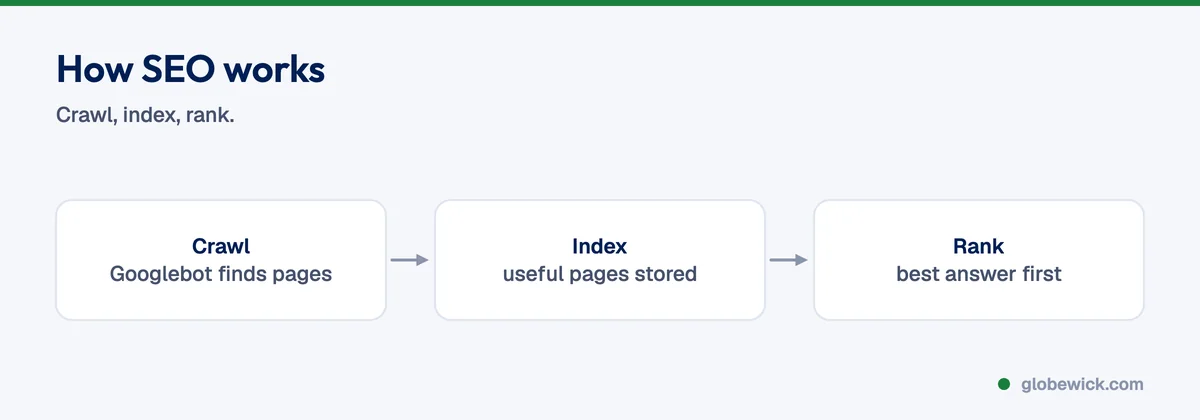
- Crawling: Google's crawler, Googlebot, follows links from page to page and reads what it finds.
- Indexing: pages that load properly and are worth keeping are stored in Google's index. A page that is not indexed cannot rank at all.
- Ranking: for every search, Google orders indexed pages using hundreds of signals, including how well the page matches the search, how useful and trustworthy it looks, how fast and mobile friendly it is, and how many relevant sites link to it.
You can see which of your pages are indexed, and which searches they appear for, in Google Search Console. It is free and is the first tool any SEO should set up. Our guide to the best SEO tools covers the rest.
The three types of SEO
Technical SEO
Making sure Google can reach, load and understand your site: a clean structure, a sitemap, no broken pages, fast loading on mobile, secure HTTPS and correct use of canonical tags. Our checklist of technical SEO basics covers the common gaps.
On-page SEO
Making each page the best answer to one search: a clear title and H1 that match how people search, helpful content that covers what the searcher wants to know, good headings, descriptive image alt text and links to related pages on your site. See our on-page SEO checklist.
Off-page SEO
Building trust from outside your site, mostly through links from other relevant websites, plus reviews, brand mentions and a complete Google Business Profile for local businesses.
SEO vs SEM vs Google Ads
- SEO earns unpaid (organic) rankings. It is slower to start but has no per-click cost.
- Google Ads (paid search, PPC) buys a place at the top of the results straight away, and you pay for every click.
- SEM (search engine marketing) is used in two ways: sometimes for paid search only, sometimes for SEO and paid search together.
Most businesses do best with both: ads for leads now, SEO to lower the cost of every customer over time. We compare them in SEO vs Google Ads.
Why SEO matters for a business
- High intent: people searching "seo agency" or "running shoes for flat feet" are already looking to buy.
- Compounding traffic: a page that ranks keeps bringing visitors without new spend.
- Trust: many people skip ads and click the organic results and the map pack.
- Lower cost per customer over time: once rankings arrive, organic leads usually cost far less than paid clicks.
SEO examples
- Local business: a dentist in Pune completes its Google Business Profile, collects reviews and adds a page for each treatment. It starts appearing in the map results for "dentist near me".
- Online store: a Shopify brand writes useful copy on its category pages and fixes duplicate product URLs, and its "cotton kurta sets" category moves onto page one.
- B2B company: a software firm publishes a guide that answers the exact questions buyers ask before a demo, and the guide becomes its biggest source of sign-ups.
How long does SEO take?
For a new or weak site, expect three to six months before meaningful results, and longer in competitive markets. Fixes to an established site, such as rewriting titles or improving key pages, can show up within weeks. SEO is a process, not a one-time task: competitors keep improving and Google keeps updating how it ranks pages.
How to start with SEO
- Set up Google Search Console and Google Analytics 4.
- Do keyword research to find the searches your customers use.
- Give each important search its own page, and avoid two pages chasing the same search.
- Fix technical problems that stop pages loading or being indexed.
- Publish genuinely helpful content and link related pages together. Our post on internal linking explains why this matters.
- Earn links and reviews, and keep your Google Business Profile complete.
- Measure clicks, rankings and, most of all, leads and sales from organic search.
If you would rather have experts do it, see our SEO services, local SEO and ecommerce SEO pages. For budgets, see SEO cost in India and SEO cost in Australia.
FAQ
What is the full form of SEO?
Search engine optimisation (spelled optimization in American English).
What is SEO in digital marketing?
It is the channel that wins unpaid traffic from search engines. It sits alongside paid ads, social media, email and content in a digital marketing plan.
Is SEO free?
Organic clicks are free, but SEO takes time, skills and usually some budget for content, tools or an agency.
Can I do SEO myself?
Yes, for the basics: a fast site, clear pages for each service, a complete Google Business Profile and reviews. Technical fixes, content at scale and link building are where specialists help.