 GLOBEWICK
Marketing Analysis: Market Research, Competitors and Analytics

Marketing analysis is the work of studying your market, competitors and campaign data to decide where to spend next. It has two halves: market analysis, which looks outward at demand, customers and rivals, and marketing analytics, which measures what your own campaigns earn. Done well, it tells you which channels, offers and audiences to scale and which to cut.
"Marketing analytics" and "market analysis" were each searched 1,000 to 10,000 times a month in both India and the United States, while "marketing analysis" and "competitive market analysis" were searched 100 to 1,000 times a month in each country, according to Google Ads Keyword Planner data we pulled in November 2026.
At Globewick we run some version of this analysis before every new account and then every month after. This guide shows the frameworks we use, the data sources that cost nothing, and how to turn the numbers into decisions.
What is the difference between marketing analysis, market analysis and marketing analytics?
The terms overlap, and people use them loosely. Here is how we separate them:
| Term | Question it answers | Typical sources |
|---|---|---|
| Market analysis | How big is the demand, who buys, and how is it changing? | Keyword Planner, Google Trends, industry reports, customer interviews |
| Competitive market analysis | Who else sells to these buyers, and how do they win? | Competitor websites, Meta Ad Library, Google Ads auction insights, SEO tools |
| Marketing analytics | Which of our campaigns, channels and pages make money? | GA4, ad platforms, CRM, Shopify or your order system |
| Marketing campaign analysis | Did this specific campaign hit its target, and why? | Campaign reports, UTM data, sales data |
"Marketing analysis" usually means all of these together: an honest picture of the market and of your own performance in it.
How do you do a market analysis?
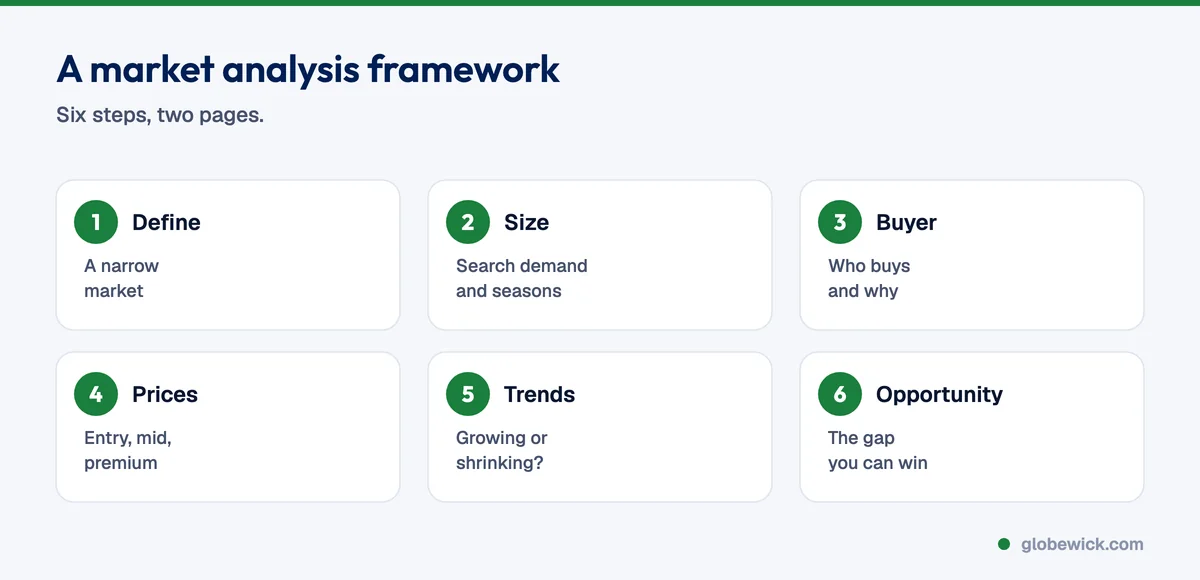
A useful market analysis framework for a small or mid-sized business fits on two pages. We follow these steps:
- Define the market narrowly. Not "skincare" but "vitamin C serums for women aged 22 to 35 who buy online". A narrow definition gives numbers you can act on.
- Size demand with search data. Use Google Ads Keyword Planner for monthly search ranges by country, and Google Trends for seasonality. Our keyword research guide shows how to group keywords by intent.
- Profile the buyer. Who buys, why, what they compare, and what stops them. Talk to ten customers before you trust any survey. Then segment them, as explained in our guide to segmentation, targeting and positioning.
- Map the price bands. List what rivals charge at entry, mid and premium level. Where do you sit, and is there room?
- Check the trends. Is the category growing, flat or shrinking? Are new formats, channels or regulations changing it?
- Write the opportunity. End with one paragraph: the gap you can win, and the evidence for it. This is your marketing opportunity analysis.
Example: market analysis for a food business
For a D2C food brand selling healthy snacks, we would look at search demand for the product type and for gifting terms around festivals, check quick commerce and marketplace listings for price and pack sizes, read reviews of the top sellers for complaints (taste, freshness, packaging), and check whether rivals sell through Instagram, Google Shopping or marketplaces. The output is a short list: the price point, the pack size, the claim that stands out, and the first two channels to test.
How do you do a competitor analysis in marketing?
Competitor analysis shows you what already works in your market so you do not pay to rediscover it. Pick three to five direct competitors and look at each through the same lens:
- Positioning: what they promise, who they speak to, how their homepage headline reads.
- Offer and price: bundles, discounts, free shipping thresholds, guarantees.
- Paid ads: search the Meta Ad Library for their live ads. Ads that have run for months are usually profitable. In Google Ads, auction insights shows who you compete with on your keywords.
- SEO: which pages bring them traffic and which keywords they rank for. Free trials of SEO tools are enough for a first look. See our list of the best SEO tools.
- Social and content: what they post, which formats get engagement, which creators they work with.
- Reviews: the complaints in their reviews are your opportunities.
Keep it in a simple table with one row per competitor. Update it every quarter.
What is keyword analysis in marketing?
Keyword analysis is market research using search data. The words people type tell you what they want, in their own language, and roughly how many of them want it. For marketing analysis it answers three questions: how much demand exists, which problems people search for most, and which of those searches show buying intent. A rise in searches for "best [product] for [problem]" is one of the clearest early signs of a growing niche.
What is marketing analytics and what should you measure?
Marketing analytics is measuring what your marketing earns. The trap is measuring what is easy (likes, impressions, clicks) instead of what matters (revenue, profit, qualified leads). We track numbers in three layers:
- Business numbers: revenue, new customers, customer acquisition cost, contribution margin, repeat purchase rate.
- Channel numbers: cost per purchase or lead, return on ad spend, conversion rate by channel.
- Diagnostic numbers: click-through rate, cost per thousand impressions, landing page speed, add to cart rate.
Business numbers decide; diagnostic numbers explain. Our guide on how to know if your marketing is actually working lists the five we check every month, and how to calculate your real customer acquisition cost shows the maths behind the most important one.
How do you use Google marketing analytics tools?
Google gives you most of what a small business needs for free:
- Google Analytics 4: traffic, conversions and revenue by channel, landing page and device. Set up key events for purchases and leads first, or nothing else is reliable.
- Google Search Console: the searches you appear for, clicks and average positions. See our Search Console guide.
- Google Ads reports: search terms, auction insights and conversion data.
- Looker Studio: a free dashboard tool that pulls GA4, Ads and Search Console into one view.
- Google Tag Manager: manages your tracking tags without editing site code each time.
Expect GA4 and your ad platforms to disagree on numbers. They count conversions differently. Our post on why ad platforms and analytics disagree explains why and how to read both.
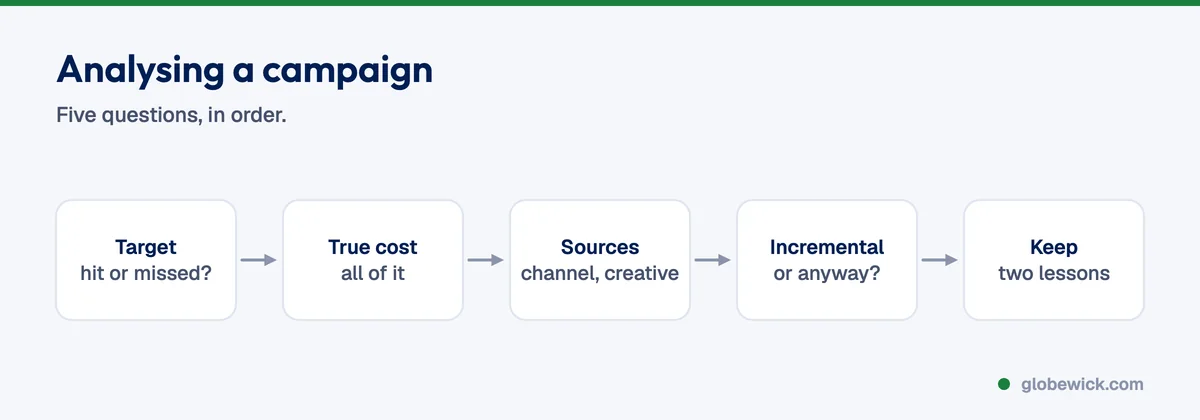
How do you analyse a marketing campaign?
Marketing campaign analysis should start before the campaign launches, by writing down the goal and the number that defines success. Afterwards, answer these in order:
- Did it hit the target? Compare the result to the goal, not to last month.
- What did it really cost? Include ad spend, discounts given, creative production and fees.
- Where did results come from? Break down by channel, audience, creative and landing page.
- Was it incremental? Would those sales have happened anyway? Compare against a period or region without the campaign where possible.
- What do we keep? Write down two or three lessons and the creative or audience to reuse.
Return on ad spend is the number most people quote, but it hides margin. Read what a good ROAS really is before judging a campaign on it alone.
What do the large consultancies say about marketing analytics?
Firms such as McKinsey publish regular research on marketing analytics, and the recurring theme is that companies get more value from acting on a few trusted numbers than from building ever larger dashboards. Their work on marketing mix modelling and incrementality testing has also become relevant for smaller brands, because privacy changes have made click-based attribution less complete. You do not need a consultancy budget to apply the idea: run simple holdout tests, compare periods with and without a channel, and trust blended numbers such as total revenue divided by total marketing spend.
Marketing analysis in India and global markets
In India, cash on delivery, marketplace sales and WhatsApp orders mean a lot of revenue never shows up in GA4. We reconcile ad data with the order system every week, track return to origin rates, and count WhatsApp enquiries with tagged links or separate numbers. Search demand also varies sharply by language and city tier, so we check Hindi and regional terms in Keyword Planner too.
In the United States, United Kingdom and Australia, privacy rules and consent banners reduce the share of visitors you can track. Server-side tracking, the Meta Conversions API and Google's enhanced conversions close part of the gap. Clients in these markets also tend to ask for incrementality tests earlier, because acquisition costs are higher.
How often should you run a marketing analysis?
- Weekly: ad performance, spend pacing and creative results.
- Monthly: business numbers, channel mix and customer acquisition cost.
- Quarterly: competitor review and a refresh of the market analysis.
- Yearly: a full market analysis before you set budgets.
If you want this done for you alongside the campaigns themselves, see our marketing services.
FAQs
What is the main purpose of marketing analysis?
To make better spending decisions. It shows where demand is, how you compare with competitors, and which of your activities bring profitable customers, so you can put more money behind what works.
What is a simple market analysis framework?
Define the market, size demand, profile the buyer, map competitors and prices, check trends, then write the opportunity in one paragraph. SWOT and Porter's five forces can help, but the six steps above are enough for most businesses.
What tools do I need for marketing analytics?
Most small businesses can start with Google Analytics 4, Search Console, Google Tag Manager, Looker Studio and the reporting inside Meta and Google Ads. Add a CRM if you sell through leads.
How is marketing analytics different from web analytics?
Web analytics measures what happens on your website. Marketing analytics joins that with ad spend, sales and customer data, so you can see the return on each channel, not just traffic.
What is competitive market analysis?
It is a structured review of the businesses competing for your customers: their positioning, prices, channels, ads, content and reviews. It shows you gaps to target and tactics that already work in your market.