 GLOBEWICK
Generative Engine Optimization (GEO): How to Get Cited by AI Search
Generative engine optimization (GEO) is the work of getting your brand, pages and facts included and cited in answers written by AI tools such as ChatGPT, Google's AI Overviews and AI Mode, Gemini, Perplexity, Claude and Microsoft Copilot. Traditional SEO aims for a ranking on a results page. GEO aims for a mention inside the answer itself. The two overlap heavily: AI engines mostly read pages that already rank well in Google and Bing, so GEO builds on good SEO and adds clear, quotable answers, structured data, fresh facts and mentions of your brand on other trusted sites.
"GEO SEO" and "AI SEO tools" were each searched 1,000 to 10,000 times a month in both India and the United States, according to Google Ads Keyword Planner data we pulled in November 2026.
How do AI engines choose which sources to use?
Most AI search tools work in two steps. First they search: ChatGPT search relies largely on Bing's index and its own crawler, Google's AI features use Google's index, and Perplexity runs its own search. Then a language model reads the top results and writes an answer, linking to some of the pages it used. That means a page has to be:
- Crawlable and indexed by the search engine behind each AI tool, including Bing, not only Google.
- Relevant to the exact question the user typed, which is usually longer and more conversational than a classic keyword.
- Easy to quote: a clear answer in one or two sentences near the top of the page or section.
- Trusted: written by a real business or expert, consistent with what other sites say, and recently updated.
GEO vs SEO vs AEO: what is the difference?
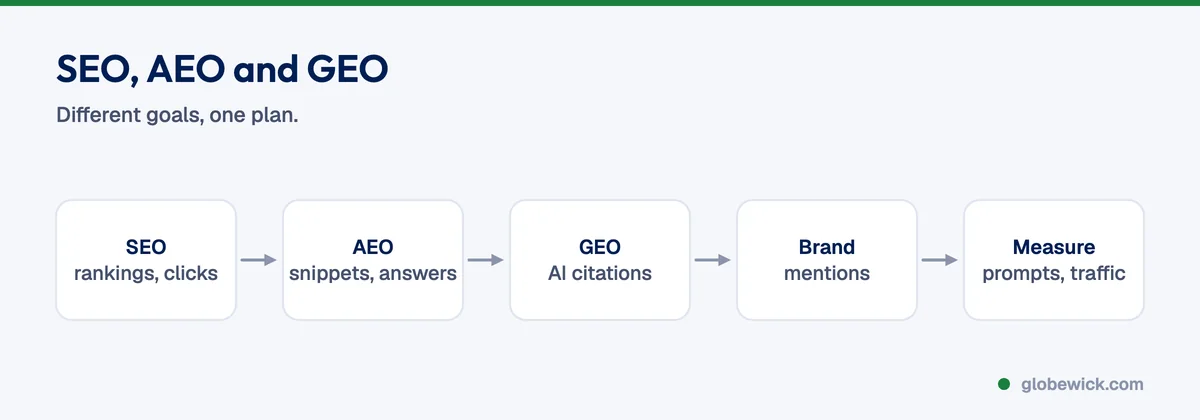
- SEO (search engine optimization) earns rankings and clicks from Google and Bing results pages. See what SEO is.
- AEO (answer engine optimization) shapes content into direct answers for featured snippets, voice assistants and AI answers. See our answer engine optimization guide.
- GEO covers the full picture for generative AI: answers, brand mentions, recommendations and citations across ChatGPT, Gemini, Perplexity and the rest.
In practice one plan covers all three. The same page that ranks, wins a snippet and gets quoted by ChatGPT usually has the same qualities.
How to do generative engine optimization, step by step
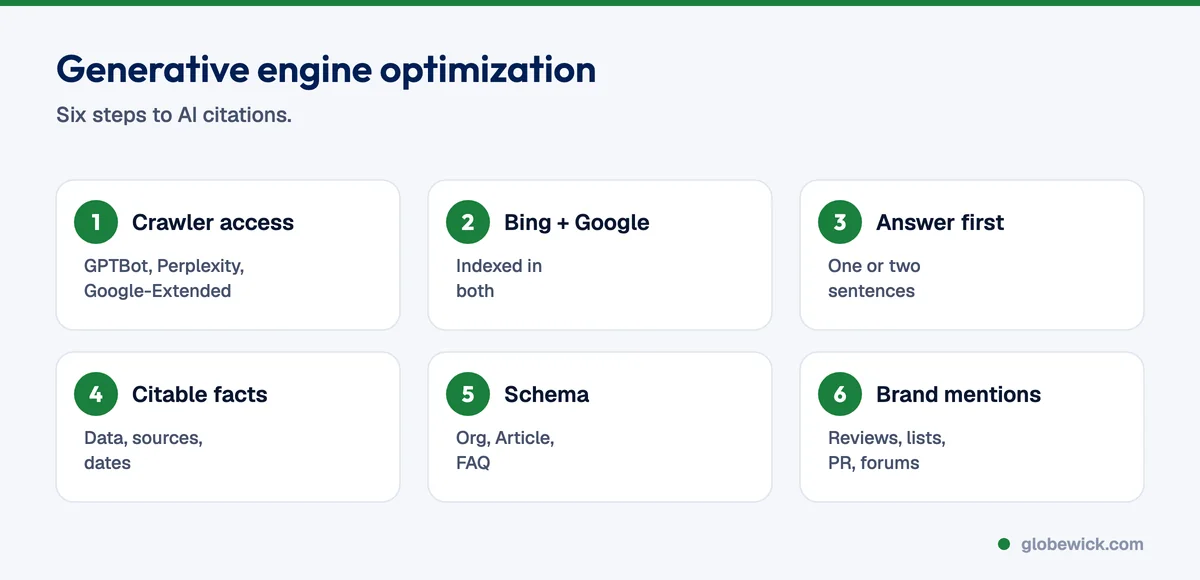
1. Let AI crawlers in
Check that your robots.txt and firewall do not block GPTBot, OAI-SearchBot, ChatGPT-User, PerplexityBot, ClaudeBot, Google-Extended or Bingbot. Some hosting and security settings block "AI bots" by default. If they cannot read your pages, they cannot cite them.
2. Get indexed in Bing as well as Google
Verify your site in Bing Webmaster Tools, submit your sitemap and use IndexNow so new pages are found within hours. Many businesses only ever check Google Search Console. See our Google Search Console guide for the Google side.
3. Answer the question first
Start each page, and each major section, with a one or two sentence answer, then explain. Use the question as the heading where it fits, for example "How much does SEO cost in India?" rather than "Pricing".
4. Add facts AI tools can cite
Original data, specific numbers with sources and dates, clear definitions, steps and comparisons are quoted far more often than general opinion. Our guides use Keyword Planner data we pull ourselves for exactly this reason.
5. Use structured data
Organization, LocalBusiness, Article, FAQPage, Product, Review and BreadcrumbList markup help search engines understand who you are and what each page answers.
6. Build your brand entity
AI models describe brands using what many sources say about them. Keep your name, address, phone, services and description consistent on your website, Google Business Profile, LinkedIn, directories and review sites. See our Google Business Profile guide.
7. Earn mentions on other sites
When people ask "what is the best agency for X", AI tools lean on lists, reviews, forums and articles from other sites. Digital PR, reviews, expert quotes, partner pages and helpful answers on communities such as Reddit and Quora all count. See our link building guide.
8. Keep pages fresh
Update key pages when facts change and show the updated date. AI answers often prefer recent sources for anything involving prices, tools or platform rules.
9. Add an llms.txt file
An llms.txt file is a plain text summary of your business with links to your most useful pages, placed at yoursite.com/llms.txt. It is a young, proposed standard and no AI company has confirmed using it for ranking, but it is quick to add and helps AI tools that do read it.
How do you measure GEO?
- Prompt tracking: keep a fixed list of 20 to 50 questions your buyers ask, run them in ChatGPT, Gemini, Perplexity and Google AI Mode every month, and record whether your brand is mentioned, cited or recommended.
- Referral traffic: in Google Analytics, look for sessions from chatgpt.com, perplexity.ai, gemini.google.com and copilot.microsoft.com.
- Search Console: AI Overviews and AI Mode traffic is included in your Google Search Console performance report.
- Branded searches: people who see you recommended by AI often search your name afterwards.
Common GEO mistakes
- Blocking AI crawlers by accident through a security plugin or CDN setting.
- Long introductions before the answer.
- Mass-produced AI content with no original facts, which gives AI tools nothing new to cite.
- Inconsistent business details across the web.
- Ignoring Bing, which powers a large share of AI search.
Want this done for you? See our AI SEO and GEO services, or read how to get your brand recommended by ChatGPT, Gemini and Perplexity.
FAQ
Is GEO replacing SEO?
No. AI search tools mostly read pages that already rank in search engines, so strong SEO is the base of GEO. GEO adds quotable answers, brand mentions and AI-specific checks on top.
How long does generative engine optimization take?
Technical fixes such as unblocking crawlers and Bing indexing can show results within weeks. Earning regular mentions and citations usually takes three to six months of consistent content and brand building.
Can you pay to appear in ChatGPT answers?
Organic ChatGPT answers cannot be bought. Some AI platforms are testing ads, but being cited in the answer itself depends on your content and reputation.
Does llms.txt help with AI SEO?
It may help AI tools that read it, but it is not a confirmed ranking factor for any major AI engine. Treat it as a small extra, not a strategy.