 GLOBEWICK
How to Get Your Brand Recommended by ChatGPT, Gemini and Perplexity
To get your brand recommended by ChatGPT, Gemini, Perplexity and Google's AI Overviews, you need three things: pages that AI crawlers can read and that rank in Google and Bing for your buyers' questions, clear and quotable answers on those pages, and plenty of consistent mentions of your brand on other trusted sites such as review platforms, directories, lists, news articles and forums. AI tools recommend brands that the web already talks about, so the work is part SEO, part content and part reputation building.
"GEO SEO" and "AI SEO tools" were each searched 1,000 to 10,000 times a month in both India and the United States, according to Google Ads Keyword Planner data we pulled in November 2026.
How does each AI tool find its answers?
- ChatGPT: when it searches the web, it uses its own crawler (OAI-SearchBot) and search partners, with Bing as a major source. Answers without search come from what the model learned in training.
- Google AI Overviews, AI Mode and Gemini: built on Google Search, so normal Google rankings and your Google Business Profile matter most.
- Perplexity: runs its own search with PerplexityBot and cites sources prominently.
- Microsoft Copilot: built on Bing.
- Claude: can search the web and uses its own crawlers.
The common thread: be indexed in both Google and Bing, and do not block AI crawlers.
Step 1: Check what AI says about you today
Write down 20 to 30 questions a buyer would ask, such as "best Shopify marketing agency in India", "who can run Meta ads for a skincare brand" or "SEO company in Jaipur". Ask each one in ChatGPT, Gemini, Perplexity and Google. Note which brands are named, which sites are cited and what is said about you. The cited sites show you exactly where you need to appear.
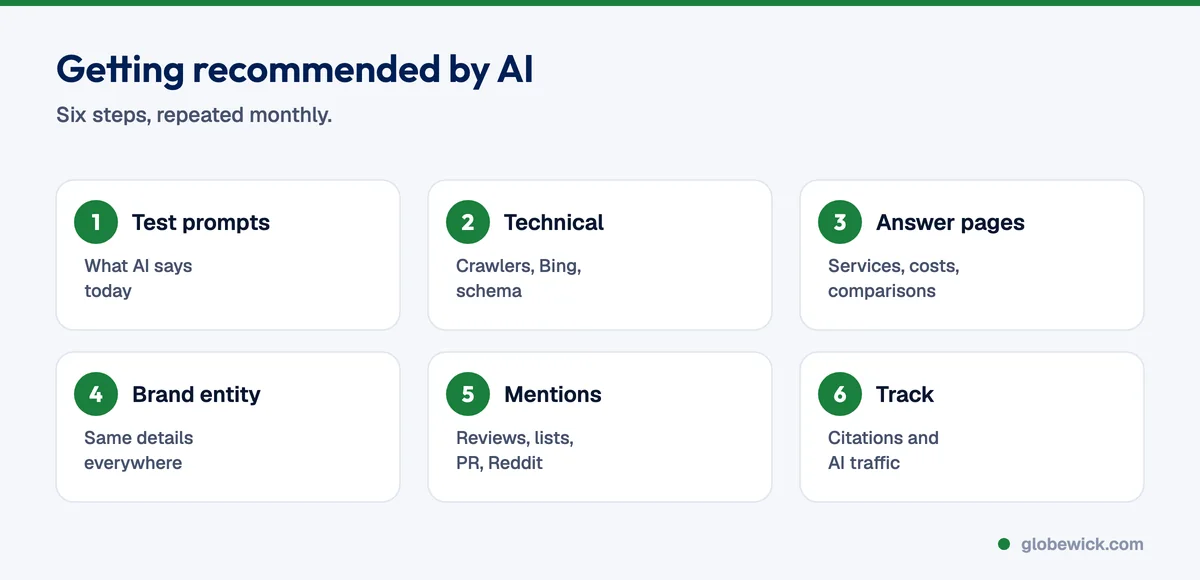
Step 2: Fix the technical basics
- Allow GPTBot, OAI-SearchBot, ChatGPT-User, PerplexityBot, ClaudeBot, Google-Extended and Bingbot in robots.txt and in your firewall or CDN.
- Verify your site in Bing Webmaster Tools and submit your sitemap, and use IndexNow for new pages.
- Make sure key content is in the HTML, not only loaded by scripts.
- Add Organization or LocalBusiness, Article, FAQPage and Breadcrumb structured data.
- Add an llms.txt file that summarises your business and links your main pages.
Step 3: Publish pages that answer buyer questions
AI tools need a page to quote for each kind of question:
- Service pages that say clearly what you do, for whom, where and how it works.
- "Best X for Y" and comparison pages, written honestly, including when you are not the right fit.
- Cost and pricing guides with real ranges and what affects them. See SEO services cost in India for an example.
- How-to guides with steps and original data.
- City and industry pages with real local detail, for local questions.
Start each page and section with a direct answer. See our answer engine optimization guide.
Step 4: Make your brand an entity AI tools recognise
- Use exactly the same name, description, address, phone and services on your website, Google Business Profile, LinkedIn, Instagram, YouTube and directories.
- Keep an About page with founding year, location, team, services and the industries you serve.
- Link your profiles to each other and to your website (the sameAs field in your Organization schema).
Step 5: Get mentioned on other sites
This is the step most brands skip, and the one AI recommendations depend on most.
- Reviews: Google reviews, plus industry review sites such as Clutch and G2 where relevant.
- Lists and directories: real industry directories, associations and "top agencies" lists.
- Digital PR: expert quotes, original data and stories journalists want.
- Communities: genuinely helpful answers on Reddit, Quora and LinkedIn, with no spam.
- Partners and clients: case studies and partner pages that name you.
- YouTube: videos answering buyer questions, which Google and AI tools also cite.
See our link building guide for how to earn these the safe way.
Step 6: Track and repeat every month
- Rerun your question list and record mentions, citations and how you are described.
- Check referral visits from chatgpt.com, perplexity.ai, gemini.google.com and copilot.microsoft.com in Google Analytics.
- Watch branded search impressions in Google Search Console.
- Update pages with new facts and dates, and fill gaps where competitors are cited and you are not.
For the full method, read our generative engine optimization guide. Want it done for you? See our AI SEO services.
FAQ
Why does ChatGPT recommend my competitors and not me?
Usually because they are mentioned on more of the sites ChatGPT reads: review platforms, lists, articles and forums. Check which sources are cited for your target questions and work on appearing there.
How long does it take to appear in AI answers?
If your pages already rank, fixing crawler access and answer structure can help within weeks. Building enough mentions to be recommended for competitive questions usually takes several months.
Do I need different content for ChatGPT and Google?
No. The same clear, accurate, well-structured pages work for both. The main difference is making sure you are also indexed in Bing and that AI crawlers are not blocked.