 GLOBEWICK
Local SEO for Australian Small Businesses: A Step-by-Step Guide
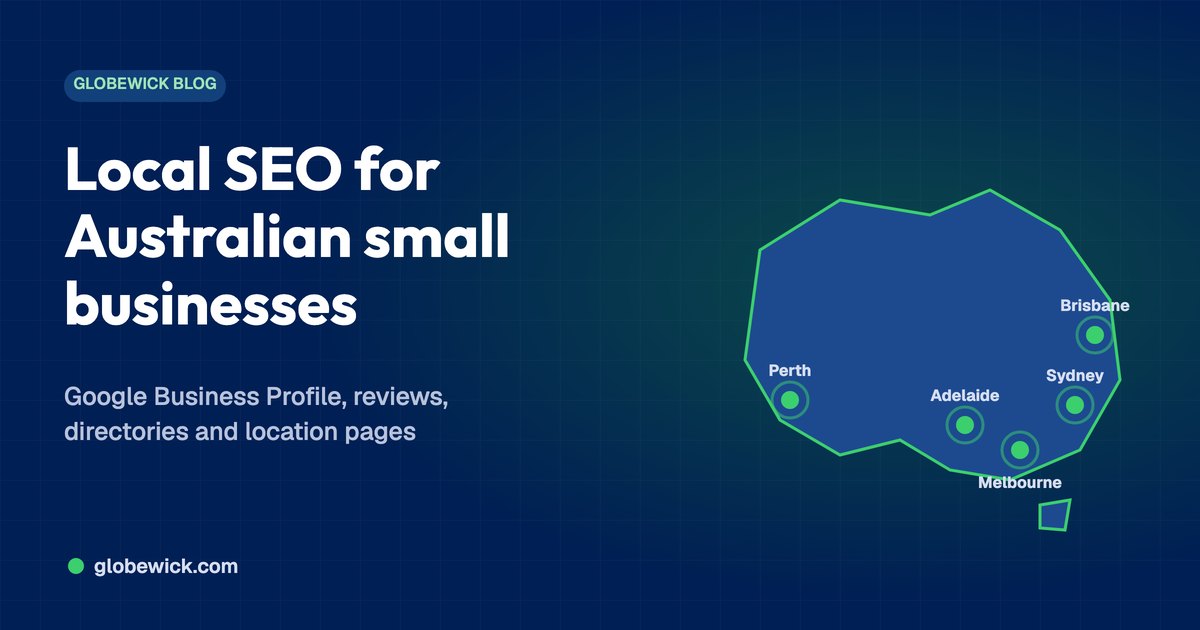
Local SEO helps your business appear when people nearby search for what you sell, such as "plumber near me", "dentist Parramatta" or "cafe Fitzroy". For Australian small businesses it comes down to five things: a complete Google Business Profile, a steady flow of genuine reviews, consistent business details across Australian directories, a website with clear service and location pages, and a few local links. This guide walks through each step in the order that usually moves rankings fastest.
Why local search matters in Australia
Local intent shows up everywhere in Australian search data. When we checked Google Ads Keyword Planner for Australia in November 2026, searches such as "seo near me", "seo agency near me" and "digital marketing agency near me" each sat in the 1,000 to 10,000 searches a month band, and the "near me" versions were growing quickly year on year. The same pattern applies to trades, health, hospitality and retail. People search with a suburb or "near me" when they are ready to call, book or visit.
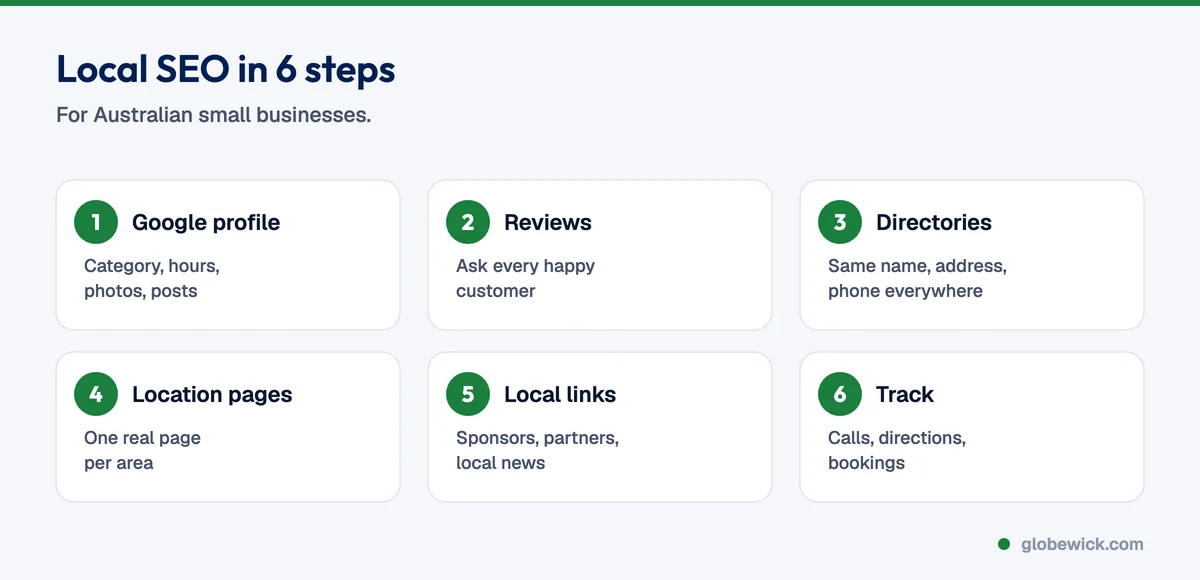
Step 1: Set up and complete your Google Business Profile
Your Google Business Profile decides whether you appear in the map results, which often sit above the normal listings.
- Claim and verify the profile at business.google.com.
- Choose the right primary category. It is the strongest single setting. Add relevant secondary categories too.
- Set your service areas if you visit customers, or show your address if customers come to you.
- Add services, products, hours and holiday hours, including public holidays such as Australia Day and Easter.
- Upload real photos of your team, premises, vehicles and work, and keep adding them monthly.
- Post updates every week or two: offers, recent jobs, events and FAQs.
Step 2: Build a review engine
Reviews influence both rankings and whether people choose you. Ask every happy customer, at the moment they are happiest, with a direct link to your review form. A text or email straight after the job works well. Reply to every review, good or bad, briefly and politely. Never buy reviews or offer rewards for positive ones: it breaches Google's policies and Australian Consumer Law, and the ACCC has taken action over fake reviews.
Step 3: Make your details consistent across Australian directories
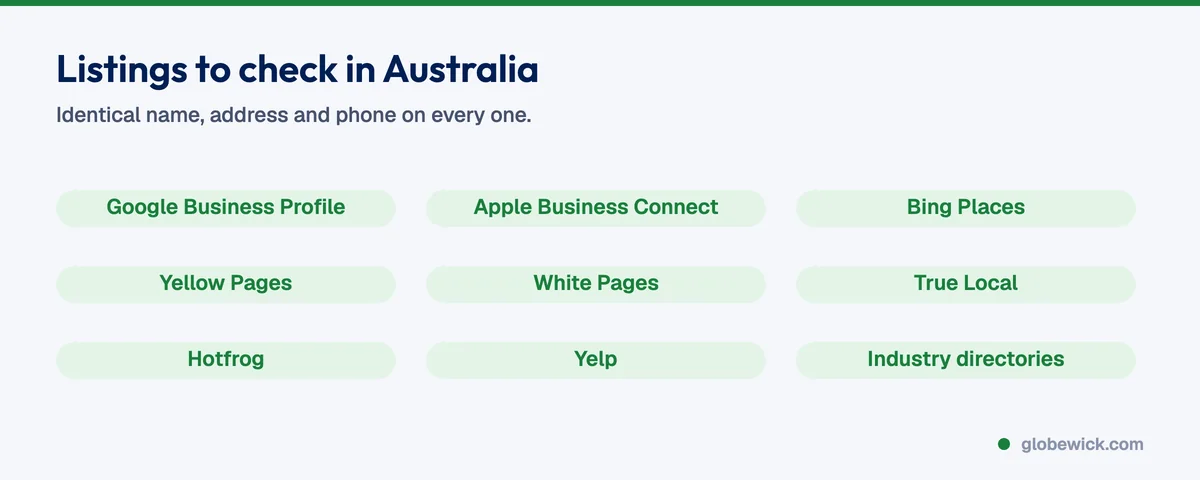
Search engines cross-check your business name, address and phone number across the web. Make them identical everywhere, including the format of your address and phone number. Start with the listings that matter most in Australia:
- Apple Business Connect (Apple Maps)
- Bing Places for Business
- Yellow Pages and White Pages
- True Local, Hotfrog and Yelp
- Industry directories and associations relevant to your trade or profession
- Your local chamber of commerce or business association
Step 4: Create service and location pages on your website
Your website still does much of the ranking work. Create one page for each main service, and a page for each key area you serve if you genuinely work there. A good location page explains what you do in that area, mentions nearby suburbs and landmarks naturally, shows reviews or jobs from that area, and has a clear phone number and enquiry form. Avoid copying the same page and swapping the suburb name: Google tends to ignore thin, duplicated pages.
- Put your suburb or city in page titles and headings where it reads naturally, for example "Emergency Plumber in Penrith".
- Add your name, address and phone number to the footer, matching your Google profile exactly.
- Add LocalBusiness schema markup with your details and opening hours.
- Make the site fast on mobile, because most local searches happen on phones.
Step 5: Earn local links and mentions
A handful of relevant local links can lift you above competitors. Good sources are local sponsorships, community events, suppliers and partners who list you, local news coverage of something genuinely interesting you did, and guest articles for local business groups. Skip paid link packages: they rarely help and can hurt.
Step 6: Track what matters
In your Google Business Profile, track calls, direction requests and website clicks each month. In Google Search Console, watch impressions and clicks for searches that include your suburb or "near me". Most importantly, ask new customers how they found you and record it. Local SEO is working when calls and bookings from Google go up, not just rankings.
Common local SEO mistakes
- Using a virtual office or PO box address, which can get a profile suspended.
- Stuffing keywords into the business name on Google, which breaches the guidelines.
- Different phone numbers on the website, Google and directories.
- No reviews for months, or reviews left unanswered.
- One generic "Areas we service" page listing 50 suburbs with no real content.
How long does local SEO take?
Google Business Profile changes can show results within weeks, especially reviews, categories and photos. Website and link improvements usually take two to four months. In competitive Sydney and Melbourne categories, expect longer. If you would like a local SEO plan for your area, see our local SEO services, our pages for Sydney, Melbourne, Brisbane, Perth and Adelaide, or contact us.
FAQ
How do I rank for "near me" searches?
You do not need "near me" on your website. Google uses the searcher's location, so focus on a complete Google Business Profile, reviews, accurate details and location pages for the areas you serve.
Can I rank in a suburb where I don't have an address?
In the map results it is hard without a real address nearby, but a service-area business can still rank in normal results with a strong, genuine location page.
How much does local SEO cost in Australia?
Many agencies charge around A$550 to A$1,500 a month for local SEO for a single location, more for multiple locations or competitive cities.