 GLOBEWICK
Social Media Advertising: Platforms, Campaigns and What Works
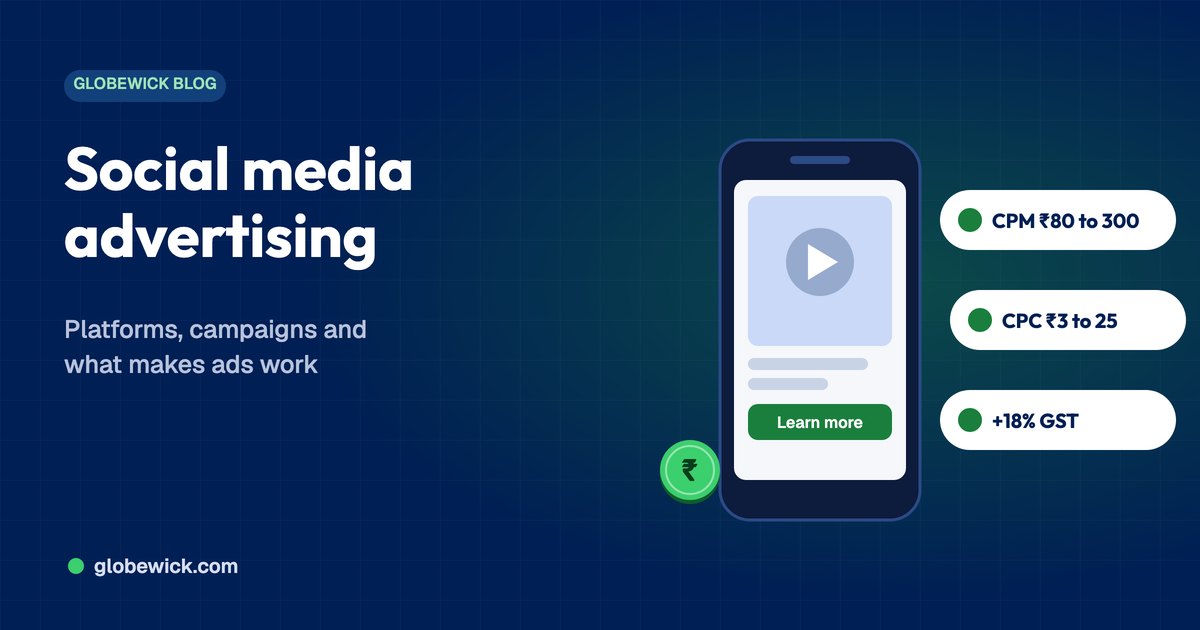
Social media advertising means paying platforms such as Facebook, Instagram, YouTube, LinkedIn, TikTok and Pinterest to show your ads to people chosen by location, interests, behaviour or past visits to your site. You pay per impression, click or result, and the best campaigns pair clear tracking with several creative angles tested at once.
"Social media advertising" and "social media ads" were each searched 1,000 to 10,000 times a month in both India and the United States, according to Google Ads Keyword Planner data we pulled in November 2026. Related terms such as "paid social media advertising" and "social media ad campaign" sit lower, in the 100 to 1,000 band in each market.
We run paid social for D2C food, fashion, beauty, supplements, fitness and healthcare brands, mostly on Meta, with YouTube and LinkedIn where they fit. This guide covers how social ads work, which platform to choose, how to set up a campaign, what makes the best social media campaigns work, and how to judge results.
What is social media advertising?
Social media advertising is any paid placement inside a social platform: a sponsored post in a feed, a video between Reels or Stories, a lead form, a carousel of products or a message ad. Unlike organic posting, you are not relying on followers or the algorithm to find you. You pick who sees the ad, set a budget and pay for delivery.
Search ads catch people who already know what they want. Social ads interrupt people who were scrolling for something else. That difference shapes everything: the hook, the offer, the landing page and the numbers you should expect. A good social ad has to earn attention in the first second, then give a reason to act.
Is paid social different from social media marketing?
Yes. Social media marketing is the wider job: content, community, creators and customer service on social channels. Paid social media advertising is the part where money buys reach and results. Most brands need both. Organic content builds trust and gives ads social proof, and paid campaigns put the best of that content in front of new buyers. For the organic side, read our social media marketing guide.
A common mistake is to treat boosting a post as a paid strategy. Boosting is quick, but it gives you fewer objectives, weaker targeting and less control over placements. We explain when each makes sense in when to boost a post vs run a proper paid campaign.
Which social media platform is best for advertising?
The best platform is the one where your buyers spend time and where the ad format suits your product. This table is how we usually start the conversation with a new client.
| Platform | Best for | Main formats | Watch out for |
|---|---|---|---|
| Facebook and Instagram (Meta) | D2C products, local services, lead generation | Feed, Stories, Reels, carousel, lead forms | Creative fatigue, tracking setup |
| YouTube | Products that need a demo, considered purchases | Skippable in-stream, Shorts, in-feed | Needs proper video, slower to read results |
| B2B, hiring, high ticket services | Sponsored content, lead gen forms, message ads | Higher cost per click than other platforms | |
| TikTok | Younger audiences, impulse products, trends | In-feed video, Spark Ads | Creative must look native, not polished |
| Home, fashion, food, weddings, gifting | Standard and video pins, shopping ads | Smaller audience in some markets | |
| Snapchat and X | Specific youth or news audiences | Story and video ads, promoted posts | Narrower use cases |
In India, Meta and YouTube carry most paid social budgets because of their reach across cities and smaller towns, and TikTok is not available there. In the United States, the UK and Australia, TikTok and Pinterest are real options for consumer brands, and LinkedIn is the default for B2B. For most of our D2C clients, Meta takes the majority of spend, because it combines reach, strong conversion optimisation and shoppable formats. Our Instagram advertising guide goes deeper on that platform.
How do social media ads work?
Every platform runs an auction each time someone opens the app. Your ad competes with others for that person's attention. The platform weighs your bid, the predicted chance that the person takes the action you chose, and the ad's quality. Better creative and cleaner tracking often beat a bigger budget.
Three settings shape delivery:
- Objective: awareness, traffic, engagement, leads or sales. The platform optimises for exactly what you pick, so choose the result you actually want.
- Audience: location, age, interests, lookalikes of past buyers, or retargeting of site visitors. On Meta, broad targeting with strong creative now often beats narrow interest stacks.
- Budget and bid: daily or lifetime budget, usually with automatic bidding to start.
Targeted advertising on social media works because platforms see so much behaviour. Since Apple's tracking changes, they see less of what happens after the click, which is why server-side tracking such as Meta's Conversions API matters.
How do you set up a social media ad campaign, step by step?
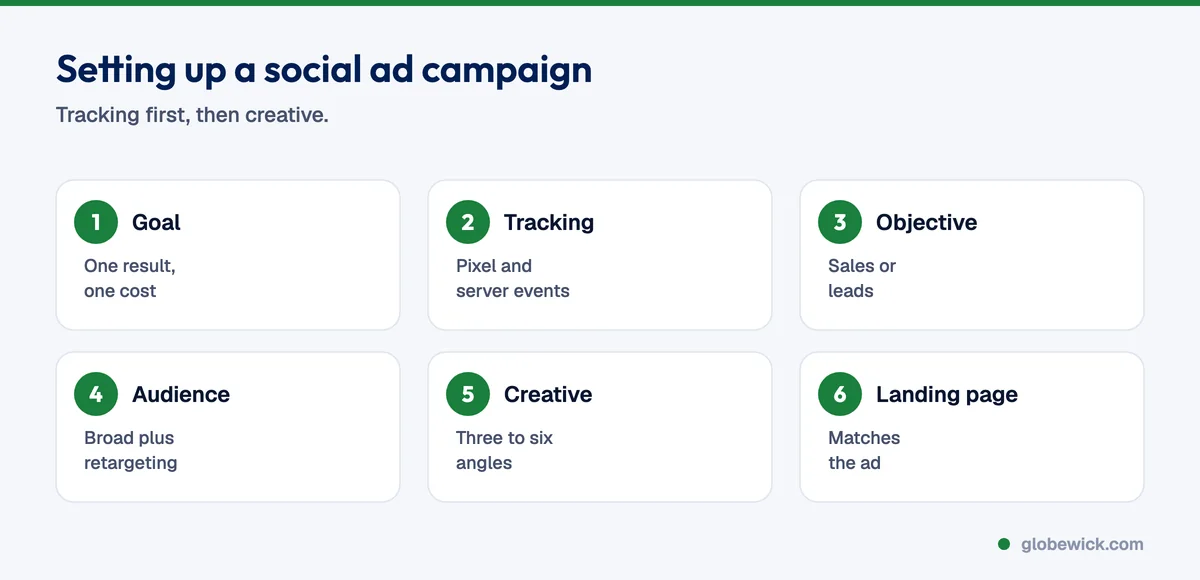
- Set one goal and one number. For example, purchases at a cost per acquisition you can afford, or qualified leads at a set cost. Work it out from your margins, not from a competitor's number.
- Install tracking first. Pixel or tag on the site, server-side events where possible, and test that purchases or leads fire correctly before spending anything.
- Pick the platform and objective. Sales or leads for performance, not reach or engagement, unless awareness is genuinely the goal.
- Define a simple audience. A broad prospecting audience in your delivery area, plus a retargeting audience of recent visitors and engaged users.
- Make three to six creatives with different angles. Not six colour variations of one ad. Different hooks, formats and messages.
- Send people to a page that matches the ad. The product or offer in the ad should be the first thing they see.
- Set a budget that allows learning. Enough that each ad set can gather results every week. Too little budget spread across too many ad sets is the most common reason new accounts stall.
- Review weekly, not hourly. Cut clear losers, move budget to winners and add new creative regularly.
Once the basics work, account structure decides how far you can scale. Fewer, larger ad sets with more creative inside them usually scale better than many small ones.
What makes the best social media advertising campaigns work?
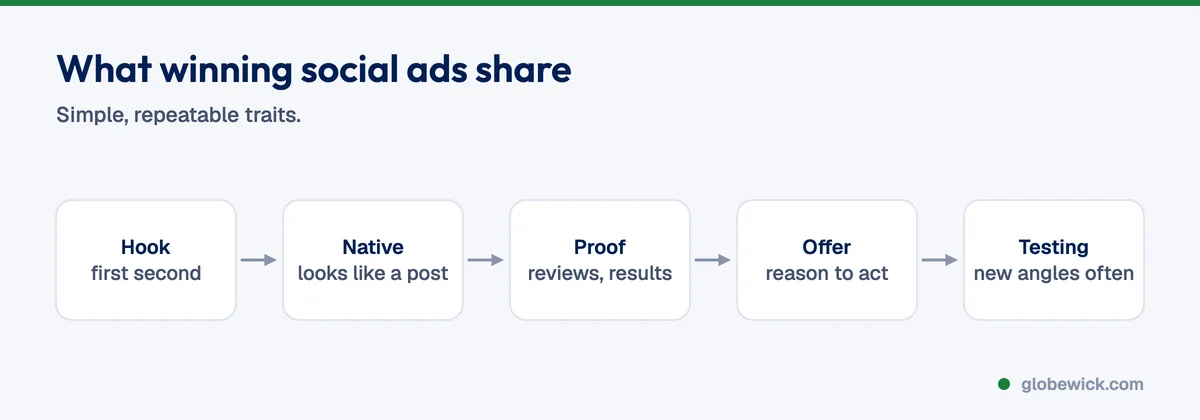
When people search for the best social media campaigns, they usually find famous brand work with huge budgets. Those campaigns are worth studying, but the lessons that transfer to a growing business are simpler. Across the accounts we manage, winning paid social campaigns tend to share five traits:
- A hook in the first second. A bold claim, a surprising visual, a problem the viewer recognises, or a face talking straight to camera.
- Native look. Ads that look like posts from a real person usually beat glossy brand films on feeds and Reels.
- Proof. Reviews, ratings, before and after, user videos and numbers the brand can stand behind.
- One clear offer. A reason to act now, such as a bundle, free shipping or a trial pack, without cheapening the brand.
- Constant testing. New angles every week or two, because even great ads wear out. Rising frequency and a falling click-through rate are the early signs.
Strong angles to test include problem and solution, founder story, customer review compilations, product demos, comparisons with the old way of doing things, and offer-led ads. Our creative testing framework explains how to test them without wasting budget.
What about social media awareness campaigns?
A social media awareness campaign optimises for reach or video views rather than sales. It can make sense for a launch, a new market, or a brand that sells offline. The risk is paying for cheap impressions that never turn into buyers. If you run awareness, set a follow-up plan: retarget video viewers and engaged users with a conversion campaign, and watch branded search and direct traffic for lift.
For most small and mid-sized businesses, we recommend starting with conversion campaigns. They create awareness as a side effect while paying for themselves.
How much does social media advertising cost?
There is no fixed price. You set the budget, and the platform charges based on auction competition. Costs depend on the country, the season, the audience, your industry and, above all, how good your ads and landing page are. Festive periods such as Diwali in India and Black Friday in the US and UK push costs up because more advertisers compete for the same users.
For Meta in particular, we break down real benchmarks and what moves them in Meta ads cost in India, with the same logic applying in other markets. In general, LinkedIn costs more per click than Meta or TikTok, but can still win on cost per qualified B2B lead.
How do you measure social media advertising results?
Judge paid social on business results, not likes. The numbers we review for every account:
- Cost per purchase or lead, and cost per qualified lead for service businesses.
- ROAS for ecommerce, read alongside margins. See what a good ROAS is.
- Click-through rate and hook rate to judge creative.
- Frequency to spot audiences seeing the same ad too often.
- New customer share to check that ads are finding new buyers, not only past ones.
Platform dashboards and Google Analytics will rarely agree. That is normal, and different attribution windows explain most of the gap. Compare trends in your own sales data against spend to see the true effect.
What are the most common social media advertising mistakes?
- Choosing engagement or traffic objectives when you want sales.
- Launching without tested tracking.
- Splitting a small budget across many ad sets and audiences.
- Running one creative until it dies.
- Sending ad clicks to the home page instead of a matching product or offer page.
- Changing settings every day, which resets learning.
- Judging results after two days instead of a full week or more.
If you would rather have a team plan, build and run your paid social, see our Meta ads agency and social media marketing services. We work with brands in every time zone from our office in Jaipur.
FAQs
What is the difference between social media ads and boosted posts?
A boosted post promotes an existing post with simple settings. A full social media ad campaign, built in a tool like Meta Ads Manager, gives you more objectives, audiences, placements and creative options, and usually performs better for sales and leads.
Which social media is best for advertising a small business?
For most consumer businesses, Facebook and Instagram are the best place to start because of their reach and targeting. B2B businesses usually start with LinkedIn, and businesses with demo-heavy products add YouTube.
How long before social media ads work?
Expect the first two to four weeks to be a learning period while the platform finds buyers and you find winning creative. Judge a campaign on at least a full week of data, and a new account on a month or more.
Is paid social media advertising worth it?
It is worth it when your product has healthy margins, your tracking works and you can produce new creative regularly. Without those three, spend tends to leak.
Can I run social media ads myself?
Yes. Many owners start themselves. An agency helps once spend grows, when results plateau, or when you need a steady flow of tested creative and someone watching the numbers every week.