 GLOBEWICK
Digital Marketing Strategy for Small Business in Australia
A digital marketing strategy for an Australian small business is a one-page plan that says who you are selling to, what you want them to do, which channels you will use to reach them, how much you will spend and how you will measure results. For most small businesses the core is simple: a website that converts, a strong Google Business Profile, search (SEO and Google Ads) to catch people already looking, social media and Meta ads to create demand, and email to bring customers back. This guide walks through building that plan step by step, with a 90-day starting roadmap.
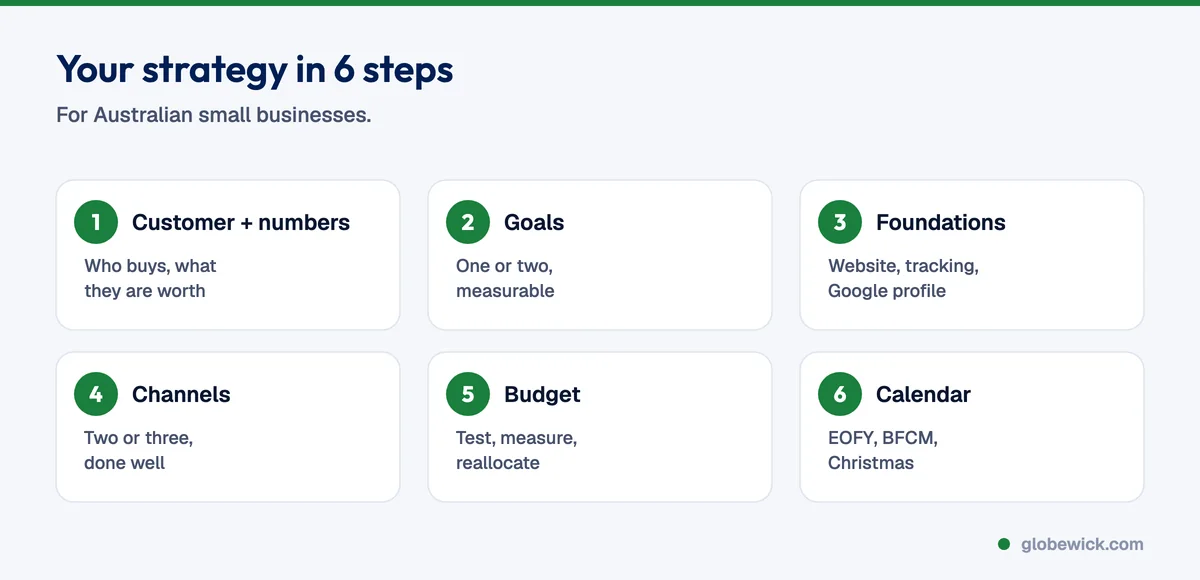
Step 1: Know your customer and your numbers
Before choosing channels, write down:
- Who buys from you: location, type of business or household, the problem they want solved and what makes them choose one provider over another.
- What a customer is worth: average order or job value, gross margin and how often customers come back.
- Your capacity: how many new customers a month you can actually serve.
- Your budget: including ad spend, agency or freelancer fees, and your own time.
These numbers tell you the most you can afford to pay for a new customer, which is the basis for every channel decision.
Step 2: Set one or two clear goals
Pick goals you can measure monthly, such as "20 qualified quote requests a month at under A$150 each" or "A$30,000 in online sales a month at a ROAS of 3". Avoid goals that do not connect to revenue, such as follower counts on their own.
Step 3: Fix the foundations
- Website: fast on mobile, clear about what you do and where, with a visible phone number, a short enquiry form or a smooth checkout.
- Tracking: Google Analytics 4, Google Ads conversion tracking and the Meta Pixel, all recording real enquiries and sales.
- Google Business Profile: complete, verified, with photos, services, hours and a steady flow of reviews.
- Offer: a clear reason to choose you now, such as a guarantee, a fast turnaround or a first-order incentive.
Step 4: Choose your channels
- Local SEO and Google Maps: essential for any business serving a local area. See our local SEO guide.
- Google Ads: the fastest way to reach people searching for your service right now.
- SEO and content: service pages, suburb pages and helpful articles that bring traffic without per-click costs over time.
- Meta and Instagram ads: strong for ecommerce, hospitality, health and any visual product or service.
- Organic social media: builds trust and keeps you front of mind, especially with short-form video.
- Email and SMS: the cheapest way to win repeat business from people who already know you.
Most small businesses do better with two or three channels done well than with six done badly. Start with the channel closest to buying intent, which for most service businesses is Google, and for most ecommerce brands is Meta plus Google Shopping.
Step 5: Plan your budget
Split your budget between working spend (ads) and the cost of doing the work (content, management, tools). Start conservative, measure cost per lead or sale for four to eight weeks, then move money to what performs. Keep 10% to 20% for testing new ideas. Remember that Google and Meta add GST to ad spend for Australian businesses.
Step 6: Plan around the Australian calendar
- End of financial year (June): big sales period for retail and a busy decision time for B2B buyers.
- Click Frenzy, Black Friday and Cyber Monday (November): peak ecommerce competition, so plan creative and budget early.
- Christmas and Boxing Day: strong for retail and gifting, quiet for many B2B services.
- January: summer holidays slow many services, while back-to-school and new-year goals drive others.
- Local events: anything from Melbourne Cup to regional festivals can matter for hospitality and tourism.
A 90-day starting roadmap
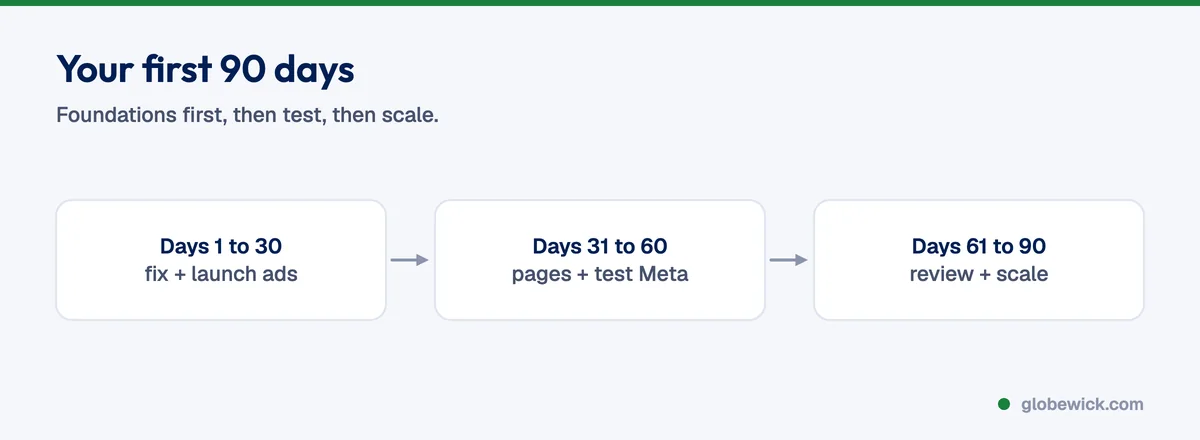
- Days 1 to 30: fix tracking, the website's key pages and your Google Business Profile. Launch a tightly targeted Google Ads campaign on your most valuable services. Start asking every customer for a review.
- Days 31 to 60: publish service and location pages, start one to two helpful articles a month, and test Meta ads with three to five creatives if your product suits it.
- Days 61 to 90: review cost per lead or sale by channel, cut what does not work, scale what does and set up a simple email follow-up for leads and customers.
How to measure your strategy
Each month, track leads or sales, cost per lead or sale, revenue by channel and how many leads became customers. Ask new customers how they found you. Review the plan every quarter and change it based on the numbers, not on what is trending.
If you want a strategy built around your numbers, see our page for Australian businesses or contact us. We do not charge GST on our fees.
FAQ
How much should a small business spend on digital marketing in Australia?
There is no fixed rule. Start from what a customer is worth and what you can afford to pay to win one, then test with a budget that can produce enough leads or sales to measure.
Which digital marketing channel is best for small businesses?
For local service businesses, Google (Maps, SEO and Ads) usually comes first. For ecommerce, Meta ads and Google Shopping usually come first.
Do I need an agency?
Not always. Many owners handle the basics themselves. An agency helps when you are spending enough on ads that better management pays for itself, or when you lack the time to do it consistently.